
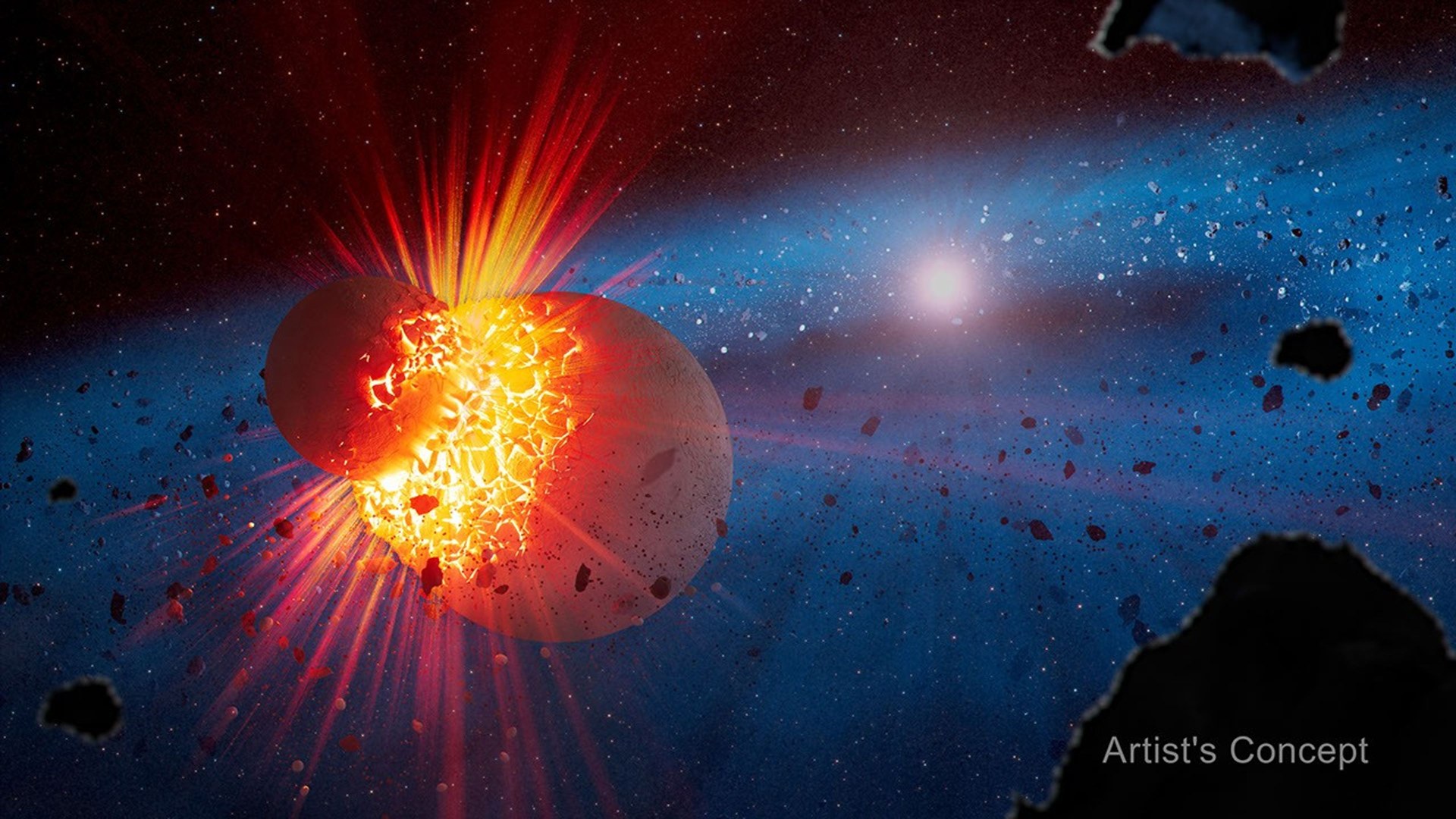
Astronomers are learning to tell different kinds of planetary collisions apart by reading the dust they leave behind. A Webb study announced on October 1 sorts unusually dusty planetary systems by their minerals, offering clues to how violently the unseen bodies struck each other. Kate Su of the Space Science Institute led the work. The appeal is direct: as coauthor Agnes Kospal told NASA, “We have no other way to study these planetary embryos directly because they are too small.” NASA’s announcement.[1]
The team combined Webb observations of 16 systems with Spitzer spectra of five more. Eight of the 21 were rich in silica; all eight fell on the younger side of 300 million years using the study’s adopted stellar ages. The researchers propose that the silica formed when energetic impacts vaporized rock, which then cooled into fresh material. The less silica-rich systems may record gentler collisions. This is a reconstruction: the observations do not show the colliding bodies or measure their masses directly. The study’s preprint was public in July; NASA announced its journal publication this week. The research.[2]
The dust is useful partly because it is temporary. In the standard picture of a debris disk, larger rocky or icy bodies collide and break into smaller pieces, which collide again. This continuing fragmentation supplies the grains that telescopes detect. Small grains can dominate the emitting area even while most of the solid mass remains locked in much larger bodies. Starlight also pushes on dust, sending some sufficiently susceptible grains out of the system. A persistent glow can therefore conceal a continuing process of destruction and replacement. The physical framework.[14]
It is also possible to see different parts of that process at different wavelengths. Warm material radiates strongly in the infrared; longer-wavelength observations can probe larger grains and cooler material. A system need not look equally active in every band. That is why astronomers combine spectra with observations spread across time and wavelength: they need to distinguish a change in the supply of dust from a change in which particles, temperatures or regions their telescope happens to emphasize.[14]
A mineral record in invisible light
To extract that record, Webb uses its Mid-Infrared Instrument, MIRI. Its medium resolution spectrometer separates light across wavelengths from 4.9 to 27.9 micrometers, well beyond human vision. Instead of recording only how bright a target appears, it measures how that brightness changes from one narrow part of the infrared spectrum to another. The resulting spectrum can carry much more information than a single image: a bright patch becomes a pattern that can be compared with the behavior of particular materials. How the instrument works.[3]
The instrument divides its field into slices and disperses their light onto detectors. Software assembles those measurements into a data cube with two dimensions describing position and a third describing wavelength. That lets astronomers keep track of where light came from while examining its spectrum. The method can work on compact targets as well as extended structures; a useful spectrum does not require a photograph that resolves every object within a system.[3]
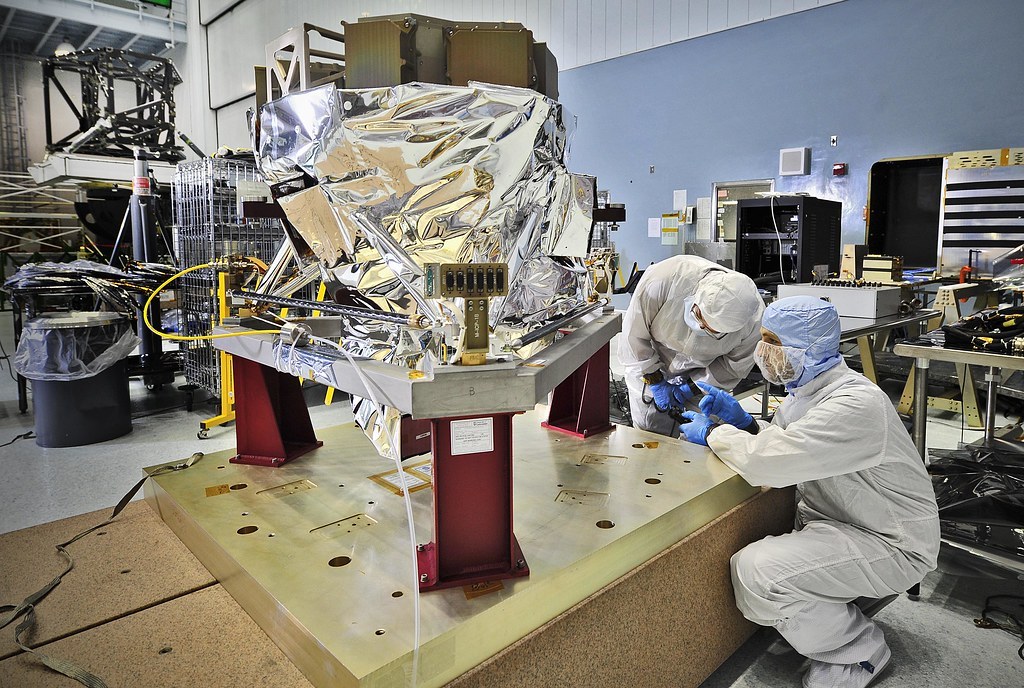
Image details
Resized proportionally; no crop or generative alteration.
The comparison library begins with rocks that scientists can hold. In a 2014 study, Andreas Morlok and colleagues measured infrared absorption by terrestrial crust and mantle materials and Martian meteorites. Some dusty systems resembled glassy materials such as obsidian and impact-produced tektites; others showed features like those of olivine- and pyroxene-bearing rocks. Testing natural mixtures mattered because a real rock has a more complicated history than a pure mineral prepared under ideal laboratory conditions. The laboratory study.[4]
Those similarities also expose a difficulty. Dust from a major collision can mix material from both bodies and from different layers within them. Heating may change its structure; vapor can condense into something new. A mineral spectrum therefore need not be an untouched sample of a vanished planet’s surface. Morlok’s team explicitly treated several possible origins as viable. Their work helps explain why finding a recognizable mineral is the beginning of an interpretation, with the collision and subsequent cooling still to be worked out.[4]
What a collision leaves behind
A collision’s outcome depends on more than the size of the objects. Zoë Leinhardt and Sarah Stewart mapped this in simulations of bodies large enough for gravity to dominate their behavior. Changing the relative masses, impact speed and angle could produce merging, cratering, fragmentation or a hit-and-run encounter. In a grazing strike, only part of the incoming body may interact strongly with its target. Counting the energy of the entire projectile as if it all struck head-on can misrepresent the encounter. Their collision models.[5]
This matters when working backward from a dust cloud. A growing world can gain material in one encounter, lose it in another, or survive while a smaller body departs damaged. Models that simply merge every pair of colliding objects leave out much of that variety. The simulations supply possible physical histories against which an observation can be tested. They also explain why a cloud of fine debris cannot, by itself, specify exactly which two bodies produced it: different initial conditions can lead to destructive outcomes.[5]
One of the strongest ways to narrow the possibilities is to keep watching. Around the young Sun-like star known as ID8, Huan Meng and colleagues saw an infrared brightening between observing seasons, followed by fading through 2013. Ground-based measurements showed the star itself was comparatively steady. After subtracting its contribution, the changing signal belonged to the surrounding dust. The decline was too rapid for a conventional, slowly evolving debris population and too slow for tiny grains simply being blown out by starlight. The ID8 observations.[6]
The researchers proposed an impact that vaporized material, followed by condensation into small rounded particles. Collisions among those particles could then replenish the fine dust that radiated so effectively in the infrared. The timing provided a constraint that the earlier spectrum alone could not supply. The telescope had missed the impact itself during a gap in observations, but the changing aftermath allowed the team to test how the cloud was being supplied and removed.[6]
Five years of monitoring made that apparently straightforward story more complicated. Su and colleagues reported that ID8 subsequently brightened, dropped sharply and brightened again. Another system, P1121, faded toward a background level while retaining shorter fluctuations. Their models showed how an orbiting, dense dust clump could present different emitting areas as the viewing geometry changed. The same material could therefore produce a changing signal without every rise marking another major impact. The longer study.[7]
The fragments’ initial sizes mattered too. A cloud dominated by particles condensed from vapor would evolve differently from a population of larger escaping boulders that needed time to grind down. In their calculations, a slow increase in emitting area could develop as the larger fragments generated smaller grains. The density of the cloud also affected that rate, leaving more than one way to reproduce a light curve. Sustained monitoring revealed the extra mechanisms and made clear which parts of the reconstruction remained ambiguous.[7]
When the dust crosses the star
HD 166191 supplied a different view. During a period of increasing infrared emission, astronomers also caught a clump crossing in front of the star. The system both grew brighter at infrared wavelengths and dimmed in visible light as the intervening material blocked the star. The depths of the dips changed with wavelength, supporting a dusty cloud rather than a single opaque companion. Su’s team reported two major passages separated by about 142 days. The transit study.[8]
If both dips came from the same cloud on a circular orbit, their spacing and shapes constrained its motion and projected size. The cloud was roughly as tall as the star and several stellar diameters wide. Its changing profile indicated rapid evolution. The authors favored debris from an impact involving bodies several hundred kilometers across. But the circular-orbit assumption mattered: a different orbit could change the inferred speed and width. Having an eclipse supplied geometry that a brightness measurement alone could not give, while still leaving the original objects unseen.[8]
Follow-up work has complicated the setting of that collision. Kadin Worthen and colleagues detected carbon monoxide around HD 166191 with ALMA and compared its millimeter dust emission with observations taken a decade earlier. They found no evidence for the kind of change at those longer wavelengths that Spitzer had seen in the infrared. Their modeling suggested gas-rich outer regions, potentially placing the system in a transition between its original planet-forming disk and a debris disk. The total gas mass remained uncertain. The follow-up research.[9]
That leaves a useful possibility: destructive collisions may begin in an inner region depleted of gas while an outer reservoir survives. It also makes the system’s evolutionary label consequential. The same apparent impact would tell a different story about when rocky worlds assemble if it occurred before the original disk had fully dispersed. Observing additional kinds of light can revise that broader history without erasing the earlier dust event.[9]
Gas can also strengthen an impact interpretation. In 2021, Tajana Schneiderman and colleagues reported carbon monoxide orbiting with debris around HD 172555. Its spectral profile placed the gas in a ring roughly six to nine times Earth’s orbital distance from its own star. The team tested several explanations, including leftover primordial material, continuing collisions in an asteroid belt and a supply of icy bodies arriving from farther out. Taken together, the gas location and previously measured dust properties favored a large impact. The gas study.[10]
A collision involving a body rich in volatile material could release gas as well as rock; atmospheric stripping was one possibility. The researchers did not establish a single unambiguous parent planet or atmosphere. How long the carbon monoxide could survive depended on how effectively other material shielded it from destructive ultraviolet light. Its detection added a separate constraint, however: an explanation now had to account for both the solid debris and the gas occupying that region.[10]
The nearby example, and the next test
The reason these distant reconstructions matter is visible much closer to home. Apollo’s lunar samples helped move the Moon’s giant-impact origin from a possibility toward the prevailing explanation. Their composition recorded extensive melting, a shortage of some easily vaporized elements and close chemical similarities with Earth. Those clues joined the Moon’s orbit and internal structure as requirements that a formation model had to explain. NASA’s account of the evidence.[11]
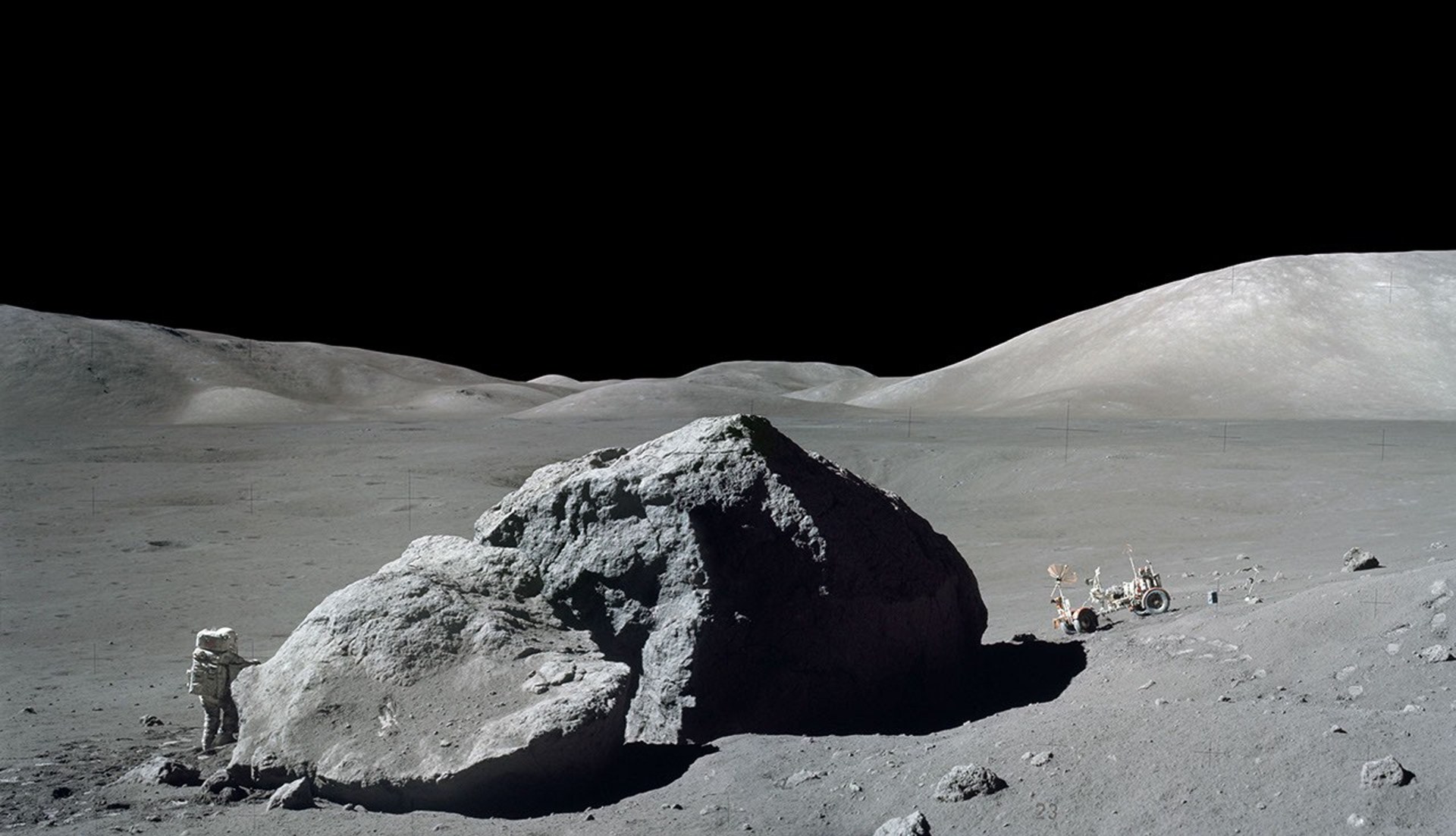
Image details
Resized proportionally; no crop or generative alteration.
Even with rocks in laboratories, researchers continue to test different versions of that event. Studying a distant dust cloud is more restricted: there is no sample return and usually no resolved view of the participants. But other systems offer something the Earth-Moon system cannot—a chance to observe an aftermath changing while it is still relatively fresh. The two approaches address different parts of the same physical problem.[11]
The Webb result now offers a population-level clue, with an important boundary: only three of its systems are older than 300 million years. The absence of silica-rich disks among those three needs testing in a larger sample. Mineral mixtures also overlap; “silica-poor” does not mean untouched rock. These are patterns to investigate, rather than a universal clock for planetary growth.[2]
Sources & further reading
Original reporting and research behind this article.
- NASA’s October 1 announcementSource dated 2026-10-01; checked October 2, 2026
- Su and colleagues: extreme debris disksPreprint posted July 7, 2026; NASA announced journal publication October 1; checked October 2, 2026
- MIRI medium resolution spectroscopychecked October 2, 2026
- Morlok and colleagues: laboratory spectra of planetary materialsIcarus paper, 2014; author manuscript deposited 2022; checked October 2, 2026
- Leinhardt and Stewart: outcomes of planetary collisionsAstrophysical Journal paper, 2012; checked October 2, 2026
- Meng and colleagues: the changing dust around ID8Science paper, 2014; author manuscript deposited 2015; checked October 2, 2026
- Su and colleagues: five years watching ID8 and P1121Manuscript revised April 19, 2019; checked October 2, 2026
- Su and colleagues: a dust cloud crossing HD 166191Source dated 2022-03-04; checked October 2, 2026
- Worthen and colleagues: gas and dust around HD 166191Accepted ApJ manuscript posted November 14, 2025; checked October 2, 2026
- Schneiderman and colleagues: carbon monoxide around HD 172555Source dated 2021-10-28; checked October 2, 2026
- NASA: evidence for the Moon’s formationchecked October 2, 2026
- Official debris-disk illustration and creditSource dated 2026-10-01; checked October 2, 2026
- MIRI receiving inspection photographPhotographed May 31, 2012; checked October 2, 2026
- Matthews and colleagues: debris-disk physicsResearch review, 2014; checked October 2, 2026
THE DAYBREAK / THE MORNING LETTER
A little more understanding,
every morning.
The day’s selected stories, the context behind them, and a deeper read. A considered start to your day, delivered to your inbox.
See what’s inside