
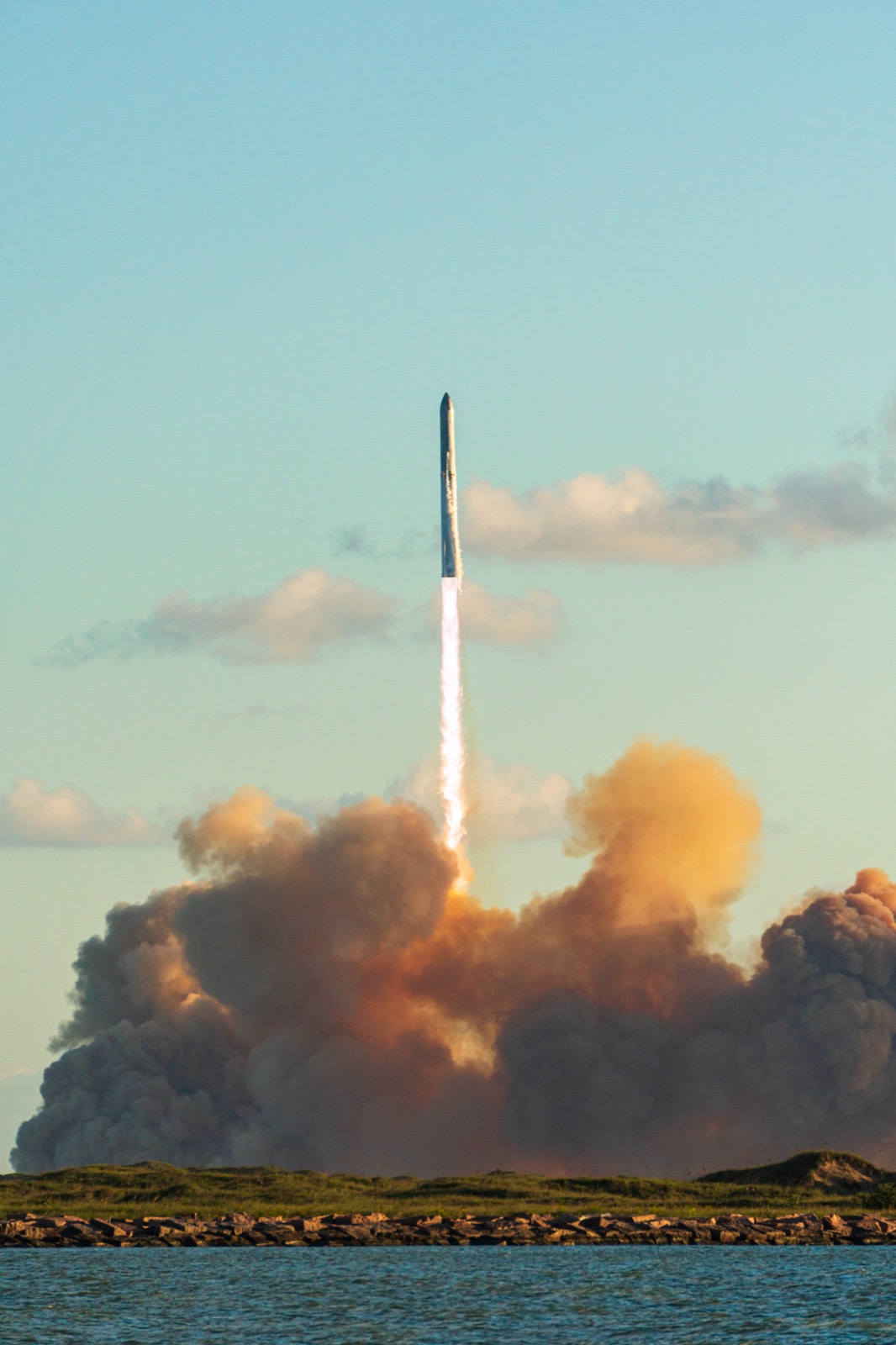
Starship reached orbit for the first time Monday, deployed 26 Starlink satellites and returned early after an engine problem. SpaceX said controllers chose a precautionary splashdown in the northern Pacific, cutting short a flight originally planned to circle Earth six times.[1]
For a few minutes, the decision to enter orbit was uncertain. SpacePolicyOnline’s Marcia Smith reported that SpaceX’s Dan Huot was explaining a plan to stay on a suborbital path when new information interrupted that account. Controllers reconsidered. Earlier payload demonstrations had returned to Earth with their ship; this time the satellites could stay.[2]
That change gives the flight a commercial significance beyond its place in the test program. The satellites are the new generation around which SpaceX has designed a substantial expansion of Starlink. In its June prospectus, the company said neither Falcon 9 nor Falcon Heavy can deploy these V3 spacecraft. Getting them into orbit therefore opens a route to growth that the company’s established launch vehicles cannot provide. Making that route dependable will require many more launches.[6]
An early return, with the payload delivered
According to SpaceX, one vacuum-optimized engine on the upper stage shut down during ascent. The other five burned longer, reaching the intended suborbital trajectory. Controllers checked the three sea-level engines before authorizing an additional burn to enter orbit. All 26 satellites were deployed and contacted. They still need checkout and orbit raising before serving customers. The company attributed the early return to caution after the ascent engine issue; it did not announce a root cause.[1]
Smith reported that deployment took about half an hour after the payload door opened. Instead of finishing six orbits and returning west of Chile, the ship headed for the northern Pacific after just over three hours. The payload deployment succeeded, while the longer orbital rehearsal was cut short.[2]
The descent ended in a sequence that William Harwood described in his report for Spaceflight Now: the ship entered belly first, used its flaps to control its attitude and reignited three engines for the flip into an upright landing position. He reported splashdown at 11:57 a.m. Eastern, north of Hawaii. The spacecraft then tipped over and exploded, his account said, as residual propellants ignited.[3]
No tower catch was attempted for either stage. The booster had already made its own ocean descent, and the upper stage’s destination was water. A controlled arrival there demonstrates something different from recovering a vehicle that can be inspected, prepared and flown again. Monday supplied an orbital departure and return; it did not supply a second flight by the same ship.[3]
Preparing a place to return
SpaceX said both possible landing areas had been cleared of air and sea traffic before launch.[1]
The FAA’s broader Starship review shows how much work surrounds such alternatives. In September, the agency completed an environmental assessment covering expanded Pacific reentry areas and additional trajectories. Its review included a northern Pacific contingency area for a particular route from Florida’s Eastern Range toward Starbase, as well as temporary airspace closures associated with returns to Boca Chica. That route is different from Monday’s Texas launch; the document does not establish the exact boundaries of Flight 14’s landing zone.[4]
An environmental finding is also only one part of permission to operate. The FAA says its commercial-space role includes public safety, environmental effects, national security, foreign-policy interests and insurance requirements. These reviews address different questions from whether an engine will continue firing. Their practical connection appears when a vehicle has to come back sooner than expected: operators need an acceptable destination and a way to keep other traffic out of it, not simply enough propellant to turn toward Earth.[4]
More capacity has several places to go
The V3 specification describes a larger communications system, rather than a faster version of a household router. Starlink says each spacecraft is designed for one terabit per second of downlink capacity and 160 gigabits per second of uplink capacity, with 2,048 beams in each direction. Those are satellite-level capabilities shared across connections. They are not a promise that an individual terminal will receive a terabit per second.[5]
The extra traffic also needs ways off the satellite. The design includes six inter-satellite laser links, each rated at 400 gigabits per second, and radio backhaul antennas operating across four frequency bands. Starlink describes custom chips that can distribute traffic among beams and adjust their density. Its figures are manufacturer specifications, not independent measurements of the 26 spacecraft launched Monday. The distinction will matter when the company begins reporting what these satellites actually deliver in service.[5]
The part of the journey below the satellites
A study presented at this year’s Web Conference gives a concrete example of why the terrestrial network matters. Researchers led by Rohan Bose examined Starlink web delivery using large public measurement datasets and controlled terminals. At their Zambia terminal, a change in the ground-network exit from Nairobi to Johannesburg coincided with a fall in median page-fetch time from 1.10 seconds to 0.47 seconds. Their analysis connected the improvement to better access to cached content.[7]
The comparison concerns selected Cloudflare-hosted pages in 2025, not V3 performance. Other routing changes produced less improvement. Starlink also published location mapping after the measurements, potentially helping content providers select servers. The result illustrates a bottleneck: adding radio capacity cannot, by itself, guarantee that a web request leaves the satellite network near an efficient copy of the requested page.[7]
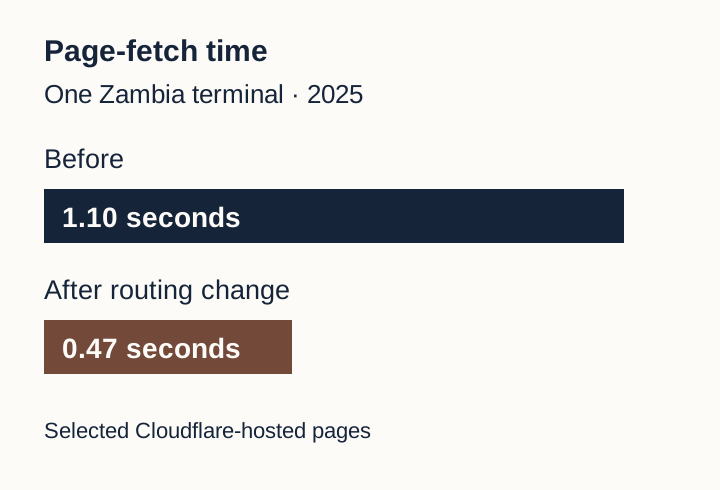
Image details
Original chart of reported medians; zero-based proportional bars.
The next test is repetition
SpaceX’s prospectus ties Starship’s commercial promise to flight frequency as well as payload. It identifies the need for manufacturing, launch infrastructure, propellant production and regulatory approvals, alongside reliable operation and rapid turnaround. The same document warns that failing to achieve full reuse would raise launch costs and slow constellation deployment. These were risks disclosed before Monday’s flight, not a new assessment of it.[6]
That dependence extends to infrastructure on the ground: the prospectus identifies electricity, air-separation facilities and methane liquefaction among the requirements for propellant supply. Those facilities will have to support repeated launches before a bigger rocket can sustain a bigger fleet.[6]
Sources & further reading
Original reporting and research behind this article.
- SpaceX: Starship Flight 14 postflight reportPostflight narrative dated September 28, 2026; checked September 29
- SpacePolicyOnline: first orbital flight, observed broadcast accountPublished September 28, 2026
- Spaceflight Now: the Pacific return, observed flight reportPublished September 28, 2026
- FAA: Starship environmental reviews and contingency return areasUpdated September 2, 2026
- Starlink: Version 3 satellite specificationsUndated technical description; checked September 29, 2026
- SpaceX EU prospectus: Starship dependencies and operating risksDated June 5, 2026; especially pages 13–14
- Bose and colleagues: Investigating Web Content Delivery Performance over StarlinkThe Web Conference 2026, April 13–17; measurements through September 2025
- Wikimedia Commons: Flight 11 photograph and licensePhotographed October 13, 2025; rights checked September 29, 2026
THE DAYBREAK / THE MORNING LETTER
A little more understanding,
every morning.
The day’s selected stories, the context behind them, and a deeper read. A considered start to your day, delivered to your inbox.
See what’s inside