
NASA has selected a space telescope to measure the cold gas that builds planets, the water in their birthplaces and the dust that hides activity in galaxies. PRIMA, announced September 23, will move into preliminary design and technology development as the first mission in the agency’s new astrophysics Probe class.[1]
The selection gives the project a path toward a 2033 launch and a planned five years of observing. It does not yet authorize construction. NASA says a further review must assess the mission’s technical readiness, cost and program before implementation can begin. The project cost ceiling is $1.2 billion, excluding launch and other non-project costs.[1]
The scientific opportunity is unusually specific. An image of a young star’s disk can reveal rings and gaps without establishing how much gas the disk contains. A galaxy can look quiet in visible light while dust conceals vigorous activity within it. PRIMA’s designers want to collect the wavelengths that help turn those appearances into measurements. Their proposed surveys connect the ingredients of individual planetary systems to the much larger history of stars and galaxies.[5][14]
Beyond Webb’s reach
Infrared is a broad region of the spectrum, and an infrared telescope does not automatically cover all of it. Webb’s Mid-Infrared Instrument, MIRI, provides spectroscopy from about 4.9 to 28.8 micrometers. That makes it useful for studying such targets as newly forming stars, debris disks and distant galaxies. It also sets a boundary: light at considerably longer wavelengths requires different instruments.[10]
PRIMA’s planned spectrometer reaches from 24 to 235 micrometers. There is a small overlap with MIRI, followed by a much larger stretch beyond its range. The comparison explains why the new mission can matter even though its mirror is smaller. The observatories will collect different information about some of the same objects. A larger photograph in an existing band would not supply a spectral line outside that band.[4]
ESA’s Herschel observatory demonstrated how productive this part of astronomy could be. It recorded more than 35,000 scientific observations before exhausting its liquid-helium coolant in April 2013. Its data traced star-forming filaments, water and dusty galaxies; the archive remained scientifically valuable after the instruments could no longer continue observing. PRIMA would bring new observing capability to questions that outlived that mission.[11]
The distinction between an image and an inventory is important here. A bright patch can indicate material worth investigating, but brightness alone is not a direct count of the gas or a complete account of the processes heating it. Observers need to separate contributions that arrive together at the telescope. PRIMA combines a surveying camera with an instrument that splits the arriving light into a spectrum, so that interesting sources can be found and then investigated in greater detail.[4]
How much planet-making material is there?
A useful precedent comes from TW Hydrae. In 2013, researchers using Herschel reported that the disk around this young star contained substantially more gas than earlier methods had suggested. The difficulty was the dominant ingredient, cold molecular hydrogen, which is hard to detect directly. Astronomers often estimated its amount through dust or other molecules, introducing uncertainty into the conversion from something visible to something largely hidden.[6]
The team instead observed hydrogen deuteride, a molecule containing ordinary hydrogen and its heavier isotope. Using the known relationship between the two forms of hydrogen, they inferred the much larger reservoir. Edwin Bergin, the study’s lead author, said in ESA’s announcement: “We did not expect to find so much gas around this 10-million-year-old star.” The result changed the assessment of how much material remained available for planets. It did not show that all of that material would become planets.[6]
PRIMA’s core plan includes high-resolution spectra of 200 planet-forming disks. The spectra would measure the water distribution, while a spectral line from hydrogen deuteride would help estimate the disk’s gas mass. Those measurements would support inferences about carbon and oxygen abundances. Such a sample could let astronomers compare planetary ingredients across many systems, rather than relying on an exceptional nearby example.[5][14]
Water poses a related interpretive problem. Herschel detected water vapor around TW Hydrae in an earlier study published in 2011. The researchers combined those observations with other data and simulations to estimate a much larger reservoir of ice on dust grains. The often-repeated comparison with thousands of Earth oceans described that inferred reservoir; it was not a photograph of oceans around the star.[7]
That history gives the new mission a concrete scientific test. Better measurements should help distinguish where material is and what form it takes, while retaining the models needed to connect the observed signal to the reservoir. A detection of water in a disk is evidence about planetary ingredients. Establishing what reaches an individual planet is a further question. The distance between those two questions is part of the work, even when a telescope is far more sensitive.[7]
Keeping the telescope cold
The observatory’s design calls for a 1.8-meter aluminum telescope cooled to 4.5 kelvins, only a few degrees above absolute zero. Its detector arrays would operate colder still, around a tenth of a kelvin. Those temperatures are central to the mission’s sensitivity: equipment that emits too much of its own thermal radiation makes faint astronomical signals harder to measure. The proposed observatory would operate near the Sun–Earth L2 region.[13]
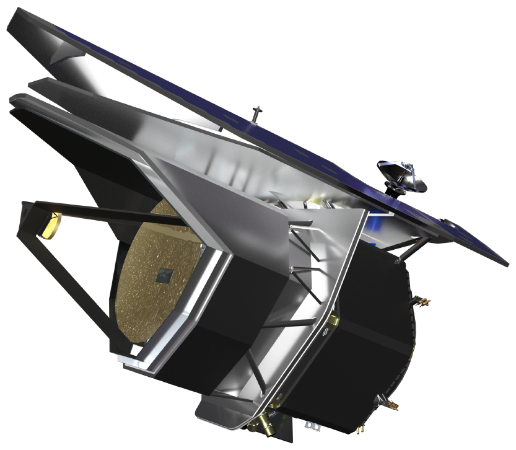
Image details
Official project illustration displayed without alteration; not AI-generated by The Daybreak.
Caltech traces a key part of the detector development to work by Jonas Zmuidzinas and JPL engineer Rick LeDuc beginning in 1999. Their superconducting detector concept progressed through ground-based and balloon instruments before the recent effort to achieve the sensitivity and durability needed in space. Zmuidzinas described the present opportunity as a sensitivity gain “by about a factor of a thousand.” That is a mission-team expectation in a particular observing domain, not an improvement to every astronomical measurement.[2]
A published detector study offers a narrower, testable view of that progress. Steven Hailey-Dunsheath and colleagues fabricated a small array and characterized a prototype pixel optimized for light near 210 micrometers. Under low loading, its measured noise was below the requirement described for PRIMA spectroscopy. The paper also explored how performance might extend to brighter sources; that extrapolation was distinct from the directly measured result.[8]
The result tests one part of the instrument. Integrating the detectors with the telescope, cooling system and electronics remains a separate engineering task.[8]
Following the activity hidden by dust
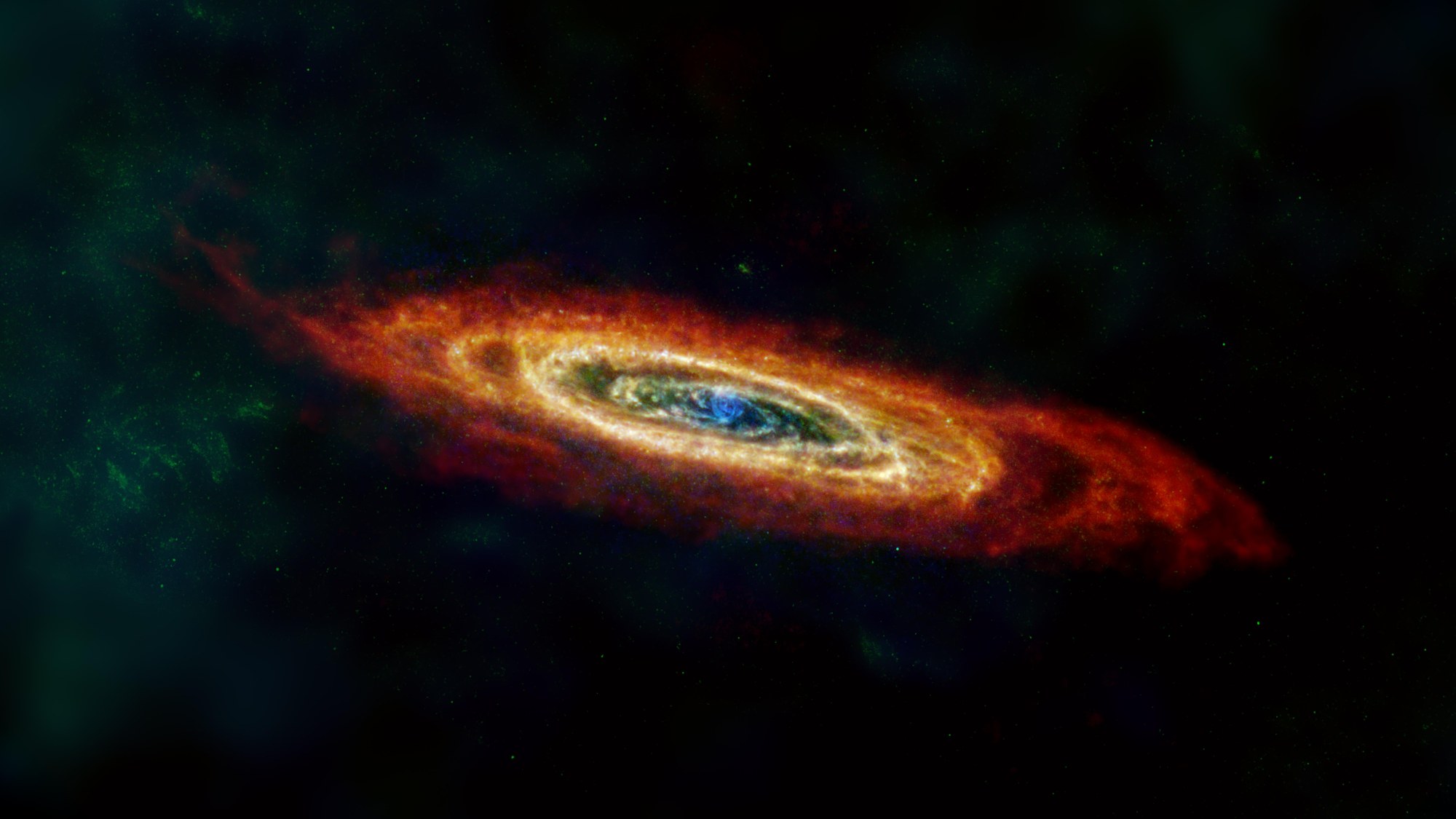
Dust is not simply an obstruction to be removed from a picture. It emits light that can be measured in its own right. A 2022 composite of Andromeda makes that especially clear: data from Herschel and other observatories distinguish cold dust, warmer dust and hydrogen gas. The colors are assigned to different measurements, not the colors a traveler would see with unaided eyes.[12]
Combining observatories also repaired a limitation of Herschel’s maps. Its fine detail did not capture all the faint, diffuse emission in a galaxy’s outskirts. Adding Planck, IRAS and COBE data helped recover the broader picture. Together, the measurements reveal structures that a single observatory could miss.[12]
For PRIMA, one important question is how galaxies acquire and lose the gas needed to make stars. Lee Armus, a mission co-investigator and IPAC science operations lead, describes a plan to expand far-infrared studies of molecular outflows from a small nearby sample to hundreds or thousands of galaxies. Such outflows carry material away from central regions and may help explain how star formation and black-hole activity develop together.[2]
The broader observing program leaves room for questions beyond the mission team’s initial surveys. About three-quarters of PRIMA’s science time is intended for general observers. Proposed uses include repeated observations of growing young stars, the role of magnetic fields in star formation, and the composition of comets and asteroids. Those programs would connect the telescope to researchers asking different questions of the same instruments.[9]
If PRIMA reaches orbit, comparisons across many disks and galaxies could help explain why similar cosmic ingredients produce such different planetary systems and galactic histories.[5]
Sources & further reading
Original reporting and research behind this article.
- NASA Selects Far-Infrared Telescope as First in New Mission ClassPublished September 23, 2026; updated September 24
- NASA Selects PRIMA Mission; Key Roles for Caltech, JPL, and IPACPublished 2026-09-23
- PRIMAUndated; accessed September 26, 2026
- PRIMA InstrumentsUndated; accessed September 26, 2026
- PRIMA PI Science ProgramUndated; accessed September 26, 2026
- Stars can be late parentsPublished 2013-01-30
- Herschel detects abundant water in planet-forming discPublished 2011-10-20
- Characterization of a Far-Infrared Kinetic Inductance Detector Prototype for PRIMASubmitted November 6, 2023; revised May 5, 2025
- PRIMA GO Science ProgramUndated; accessed September 26, 2026
- Mid-Infrared Instrument (MIRI)Undated; accessed September 26, 2026
- Herschel closes its eyes on the UniversePublished 2013-04-29
- Andromeda Galaxy Imaged by Herschel, Planck, IRAS, COBEPublished 2022-06-16
- PRIMA ObservatoryUndated; accessed September 26, 2026
- PRIMA PI Science — Origin of Planets and their AtmospheresUndated; accessed September 26, 2026
THE DAYBREAK / THE MORNING LETTER
A little more understanding,
every morning.
The day’s selected stories, the context behind them, and a deeper read. A considered start to your day, delivered to your inbox.
See what’s inside