
The bright point is small enough to overlook. In a processed infrared image of the young star Elias 2-24, it sits just outside the masked center, surrounded by mottled light. An arrow helps locate it. Beside it, a radio-telescope image shows an almost sculpted arrangement: a bright inner disk, a dark gap and a ring of material farther out. The point and the gap belong to the same developing planetary system. Getting them to tell a reliable story has taken years. 2026 confirmation study 2023 gas and infrared study[1][2]
In research published September 16, astronomers led by Andrea Bernardi at Universidad Diego Portales in Chile report confirmation of Elias 2-24 b, a giant planet still embedded in the disk around its star. Their key observations were already old: one Keck telescope dataset came from June 2018, another from June 2020. Combined with earlier observations from Chile, those records strengthened the case that the faint source was a planet rather than a trick of the instrument or an unrelated star behind the system. 2026 confirmation study[1]
The attraction is easy to understand. Our own planets are finished enough to conceal much of their construction history. Here is a world in a system estimated to be roughly a million years old or younger, still amid the material from which planets grow. The paper calls it the youngest planet detected through high-contrast imaging. Its age is an estimate, and its mass is not yet a settled measurement. Those qualifications make the discovery more interesting: the object is young enough that the usual ways of interpreting a planet's light become difficult. 2026 confirmation study[1]
What, exactly, does a planet look like before it is done becoming a planet? Elias 2-24 b offers a rare chance to answer with evidence rather than an artist's impression.
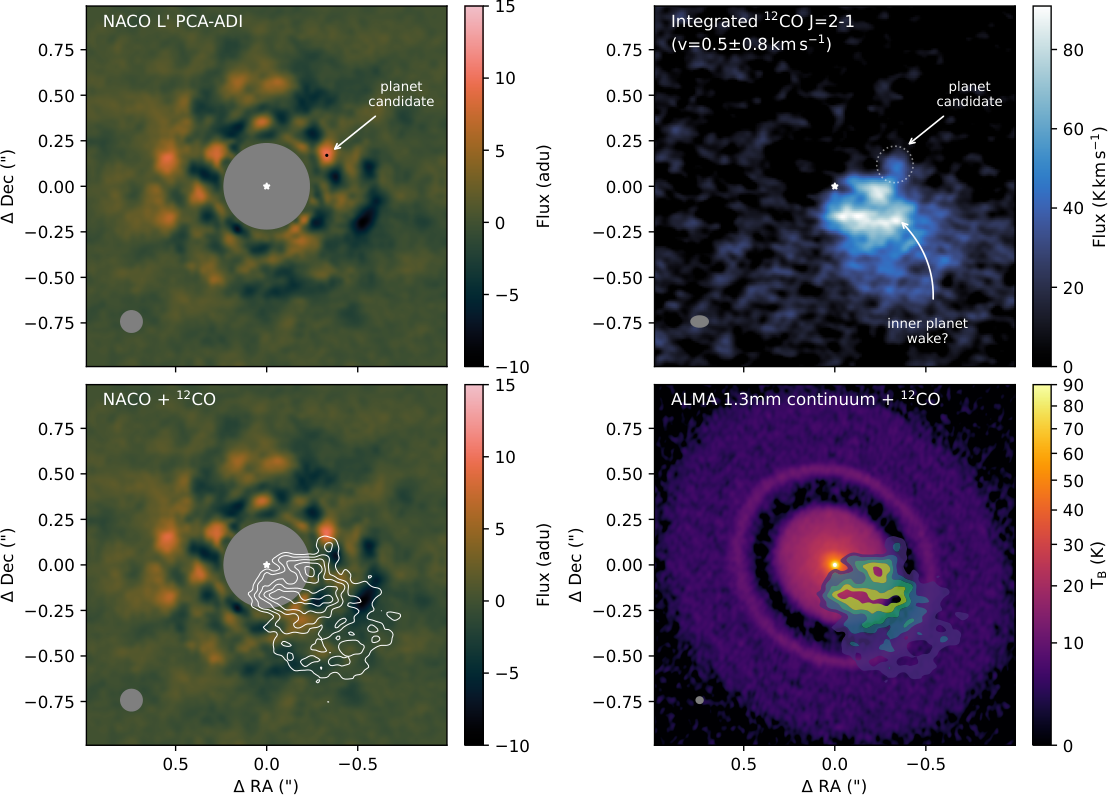
Image details
Displayed without generative alteration.
The space where a world should be
Long before the new confirmation, astronomers had reason to look closely at Elias 2-24. A 2017 study using the Atacama Large Millimeter/submillimeter Array, or ALMA, reported several partially resolved gaps in its dusty disk. A disk with structure offers a more specific question than a smooth glow. Something has arranged the material unevenly. Could a planet be responsible? 2017 disk study[3]
The familiar image of a solar system places neat, separate planets around a star. A young system is messier. The disk is both a supply of building material and a record of forces acting within it. A planet's gravity can disturb that material, producing features much larger than the planet itself. But the feature and its cause are different things. Finding a gap is an invitation to search, not a photograph of the object that made it. 2026 confirmation study 2024 dust-trapping study[1][4]
ALMA's DSHARP survey made this distinction especially vivid. It assembled detailed observations of 20 nearby protoplanetary disks, revealing an assortment of rings, gaps and spirals. Some resemble targets; others look stretched or broken into sweeping arms. Their beauty comes with a scientific problem: astronomers need to connect those shapes to the processes that produced them. A gallery of elaborate disks is not automatically a gallery of confirmed planets. DSHARP observations[5]
Elias 2-24 became an unusually promising test. Earlier work with the Very Large Telescope's NaCo instrument found a possible planet inside a gap. A subsequent analysis, published in 2023, combined the infrared source with ALMA observations of carbon monoxide gas. It identified a detached emission spot near the candidate's location, along with evidence of disturbed gas motion and local heating. Different instruments were pointing toward a related disturbance. 2023 gas and infrared study[2]
That mattered because each instrument has different strengths and different ways of misleading an observer. Infrared imaging searches for the faint source itself. Measurements of gas can reveal its possible effects on the neighborhood. Neither is a simple aerial photograph. Both depend on careful processing, and both must survive checks against less exciting explanations. 2023 gas and infrared study[2]
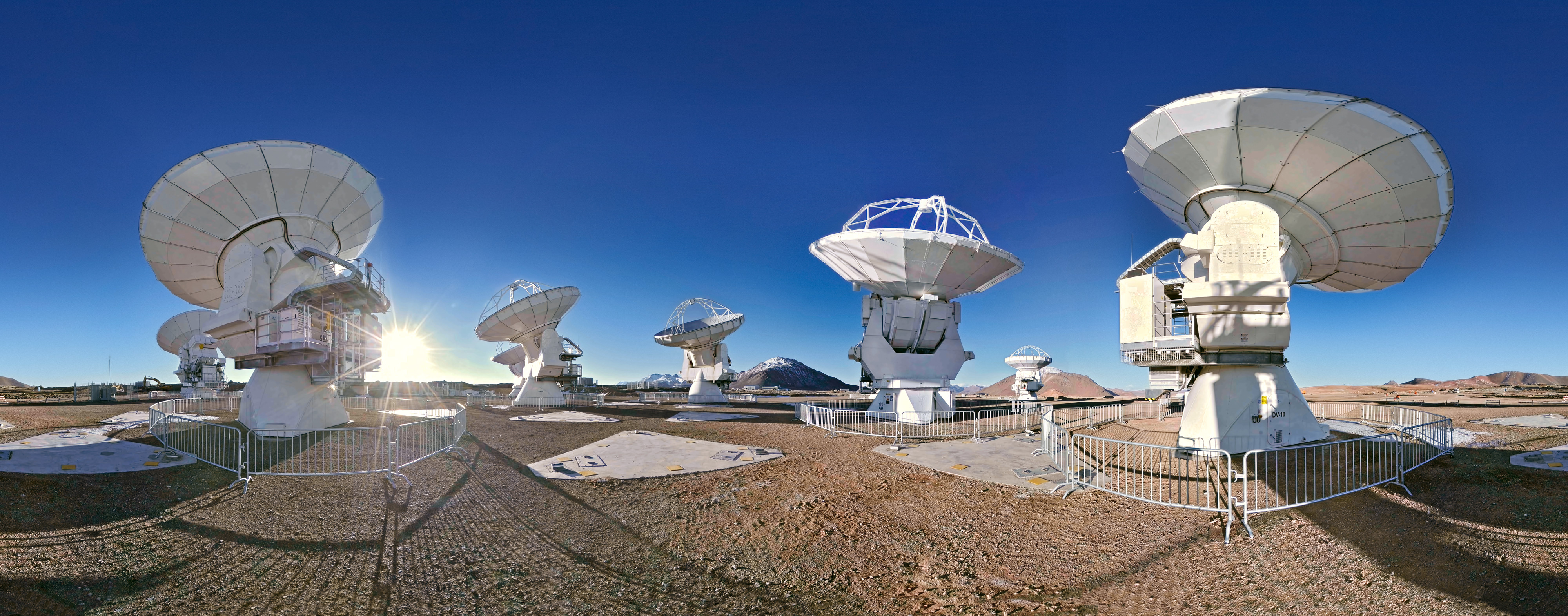
Image details
Displayed without generative alteration.
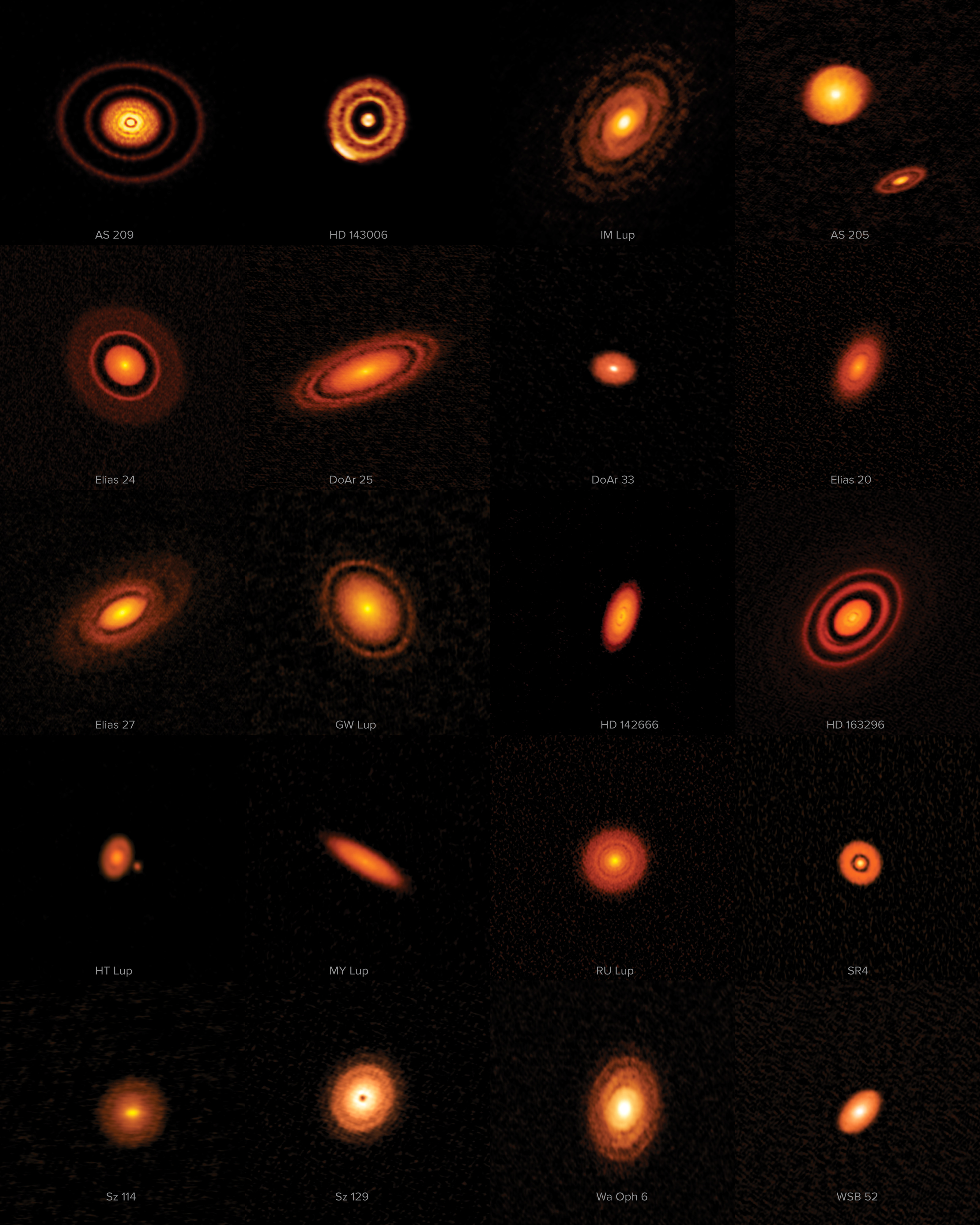
Image details
Displayed without generative alteration.
Making the star less overwhelming
The central difficulty is glare. A star can swamp the light from a nearby planet, just where an astronomer needs to look most carefully. Keck's NIRC2 camera works with a vortex coronagraph, an optical device designed to suppress starlight so fainter surroundings become easier to detect. Its patterned mask manipulates the light rather than merely placing a small, opaque circle over a star in a finished photograph. Keck coronagraph explanation[6]
That does not make every remaining bright patch a world. Atmospheric turbulence and imperfections in an optical system can leave residual patterns, commonly called speckles. The astronomer's task is to separate a real companion from this leftover light without processing away the companion in the attempt. Bernardi's team used several approaches to that problem, rather than relying on a single attractive final image. 2026 confirmation study[1]
One approach takes advantage of the way the sky's orientation changes during an observing sequence. Another uses observations of reference stars to help characterize the unwanted stellar pattern. The team applied processing built around the Vortex Image Processing software package and tested different choices within the reductions. The question was whether the source persisted when the method changed. 2026 confirmation study[1]
There is an important distinction here between revealing a weak signal and making one up. Researchers can test a pipeline by inserting a simulated companion into real data at a different location and checking whether the processing recovers it. They can also subtract a fitted companion signal at the candidate's location and inspect what remains. These are checks on the method, not additional observed planets. Both kinds of test appear in the new study. 2026 confirmation study[1]
The source was recovered in the 2018 and 2020 Keck observations. Its position agreed, within the reported uncertainties, with the previous work placing a candidate in the disk's gap. The team also compared the movement expected for an unrelated, stationary background object with the position measured at the later epoch. The observed source did not follow that background track. 2026 confirmation study[1]
A reader encountering the word “confirmed” might reasonably imagine an overwhelmingly clear point in each exposure. The paper is more nuanced. Its individual Keck detections did not reach the conventional five-sigma significance threshold. The 2020 recovery was weaker than the 2018 one; the authors identify poorer atmospheric conditions as the likely reason. Their case rests on the combined evidence: repeated recovery, processing tests, positional consistency and the earlier observations. 2026 confirmation study[1]
That is worth knowing before admiring a polished illustration. The discovery is not a close-up of striped clouds on a distant Jupiter. It is a carefully argued identification of a very faint source. The achievement lies in making the interpretation survive several different questions.
A bright planet is hard to weigh
The new study places the source about 55 astronomical units from its star in projected separation: roughly 55 times the distance between Earth and the Sun. That is a measurement on the sky, converted using the system's distance. It should not be mistaken for a complete orbit traced through space. 2026 confirmation study[1]
The mass is harder. Astronomers often compare the light from a young planet with models of how planets cool and evolve. But a forming world may still be collecting gas, and that process contributes energy. The brightness then reflects more than the heat stored inside a finished planet. If all the light is assigned to the planet's cooling, the inferred mass can be misleading. 2026 confirmation study[1]
Bernardi and colleagues report a model-dependent estimate of 1.9 to 4.0 Jupiter masses when accretion effects are left out. In their discussion, they treat this as an upper mass estimate, not a direct weighing. Models that infer a planet's influence from the disk structure can favor lower masses. The fact that different methods do not collapse neatly into one number is part of the scientific opportunity. 2026 confirmation study[1]
The earlier ALMA study encountered a related ambiguity. Its observed heating could be consistent with a more massive planet, or a lower-mass planet still actively accreting. Foreground material interfered with some of the gas measurements needed to constrain the mass. More light did not translate into one unambiguous answer. 2023 gas and infrared study[2]
This is the moment when the ordinary meaning of “baby planet” becomes useful. A growing object's appearance depends on what is happening to it now, not only on how much material it already contains. A snapshot taken during rapid growth can make a planet look different from one of the same mass at a quieter stage. The paper therefore uses the surrounding disk as another source of information, testing whether proposed planet properties fit the structures actually observed. 2026 confirmation study[1]
The authors favor formation through core accretion, in which a growing core ultimately acquires a substantial gaseous envelope. They also consider a different possibility: a planet could have formed through fragmentation in a gravitationally unstable disk and migrated inward. They regard that alternative as unlikely for this system, but do not make it logically impossible. Evidence favoring a model is not a recording of every step in the planet's past. 2026 confirmation study[1]
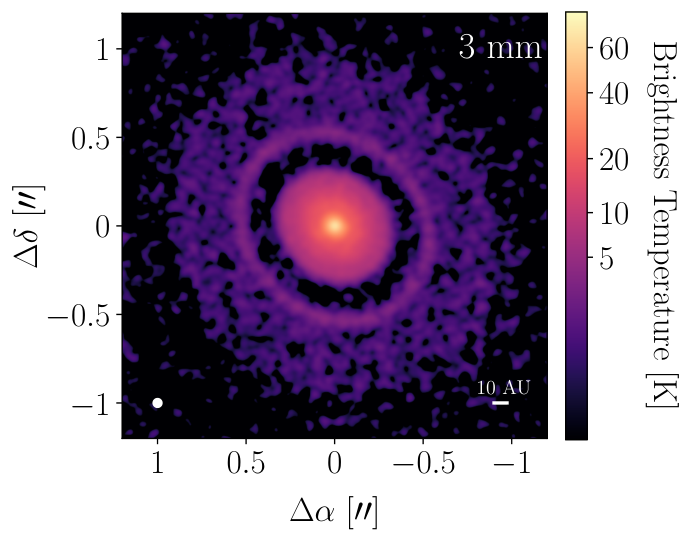
Image details
Displayed without generative alteration.
The ring is doing more than looking beautiful
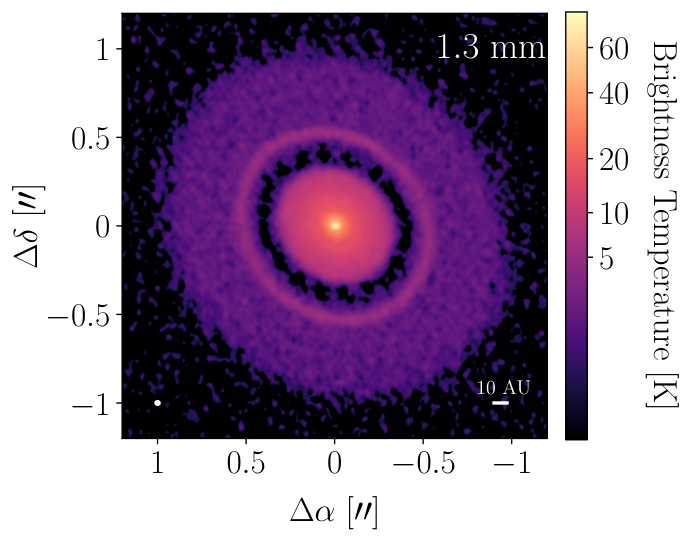
A separate 2024 study led by Adolfo Carvalho examined Elias 2-24 at two ALMA wavelengths, 1.3 and 3 millimeters. The comparison probed the bright outer ring, where dust grains appear to be accumulating. The researchers found evidence that larger grains were more tightly concentrated than smaller ones, supporting the interpretation that the ring is trapping dust. 2024 dust-trapping study[4]
The mechanism gives the image a different meaning. A planet can alter the disk's gas distribution and produce a local pressure maximum near a gap's outer edge. Drifting dust can collect there instead of continuing inward. Seen in millimeter emission, the accumulation appears as a bright ring. In this reading, a dark gap and its luminous neighbor are connected consequences of the same disturbance. 2024 dust-trapping study[4]
Such concentrations also interest researchers because gathering solids together may help the next stages of growth. But the 2024 observations do not establish that another particular planet has formed in this ring. A favorable environment, a plausible mechanism and a detected object are three different levels of claim. Elias 2-24 is valuable partly because it lets those levels be compared in one system. 2024 dust-trapping study[4]
The new confirmation sharpens that comparison. Instead of arguing only from a disk's shape to an unseen agent, astronomers have a source at the relevant location and measurements that can be tested against the disk. The planet becomes a way to calibrate the interpretation of the rings; the rings become a way to challenge estimates of the planet. 2026 confirmation study 2024 dust-trapping study[1][4]
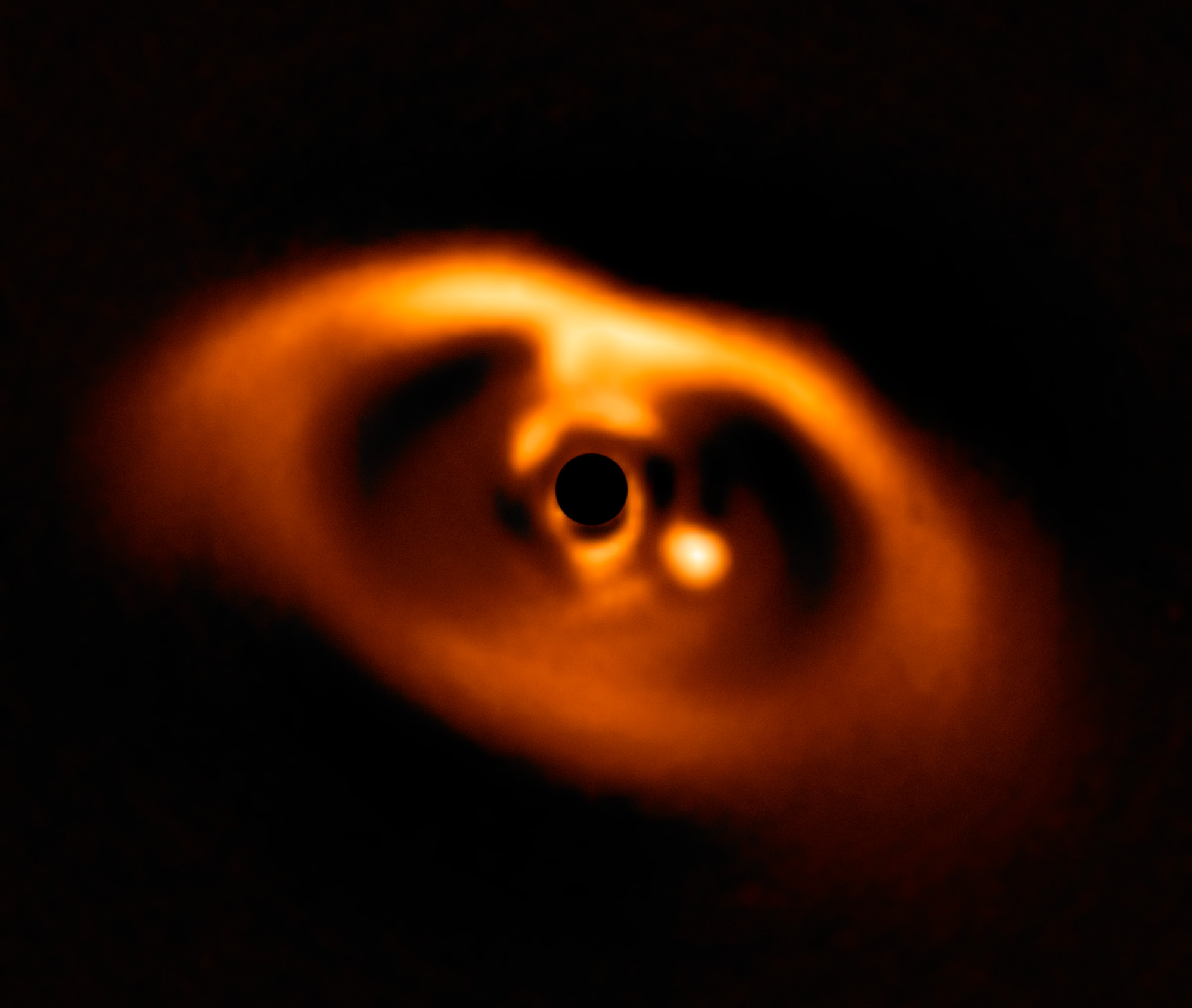
Image details
Displayed without generative alteration.
An early chapter, not the whole story
There are other observed worlds still associated with planet-forming disks. The well-known PDS 70 system offers a useful visual comparison: a coronagraphic image shows a bright point near a masked star, within surrounding disk material. ESO released that observation in 2018. It is a different system, not another view of Elias 2-24. ESO observation[7]
The age is what makes the newer result stand out. The Bernardi paper compares Elias 2-24's roughly million-year-or-younger system with the approximately five-million-year ages of PDS 70 and WISPIT 2. The authors argue that a giant planet apparently forming through core accretion so early, and so far out, puts demanding constraints on how quickly the process can operate. That is more informative than saying the discovery has simply broken science. 2026 confirmation study[1]
Age estimates, like mass estimates, depend on interpreting observations through models. The defensible claim is therefore a young system providing an unusually early view of planet formation, with the high-contrast-imaging record stated in the paper. It is not a precisely dated birthday. Nor does one planet tell astronomers that every gap in every disk has the same explanation. 2026 confirmation study[1]
The next useful observations would make the picture more specific. Keck's announcement says the team wants spectroscopy and further measurements to investigate the atmosphere, temperature, mass and continuing accretion. The paper points to higher-precision observations, including with the VLT's ERIS instrument, as a route to better constraints. A better spectrum or tighter measurement could change which models fit. Keck announcement 2026 confirmation study[8][1]
For now, the result also makes a quieter point about discovery. Telescope time from 2018 was not finished being useful when that observing run ended. Preserved data could be revisited, processed again and compared with observations taken years apart and at other facilities. The archive did not contain an obvious world waiting for a name. It contained evidence that became more persuasive when someone found a better way to ask what it meant. Keck announcement[8]
Look back at the small point beside the masked star. It is still a small point. What has changed is the account astronomers can build around it: where it sits, why a background star is a poor explanation, how the gas and dust respond, and which properties remain uncertain. A world still under construction has become a place where theories of construction can be tested.
Sources & further reading
Original reporting and research behind this article.
- Bernardi et al. — Searching for Embedded Protoplanets with the Keck/NIRC2 Vortex Coronagraph: Confirmation of a Core-accretion Planet in the Narrow Gap of the Elias 2-24 Disk; The Astrophysical Journal Letters 1009:L3 (2026), CC BY 4.0Accessed 2026-09-21
- Pinte et al. — Kinematic and thermal signatures of the directly imaged protoplanet candidate around Elias 2-24 (2023), CC BY 4.0Accessed 2026-09-21
- 2017 disk studyAccessed 2026-09-21
- Carvalho et al. — A Dust-Trapping Ring in the Planet-Hosting Disk of Elias 2-24 (2024), CC BY 4.0Accessed 2026-09-21
- DSHARP observationsAccessed 2026-09-21
- Keck coronagraph explanationAccessed 2026-09-21
- ESO observationAccessed 2026-09-21
- Keck announcementAccessed 2026-09-21