
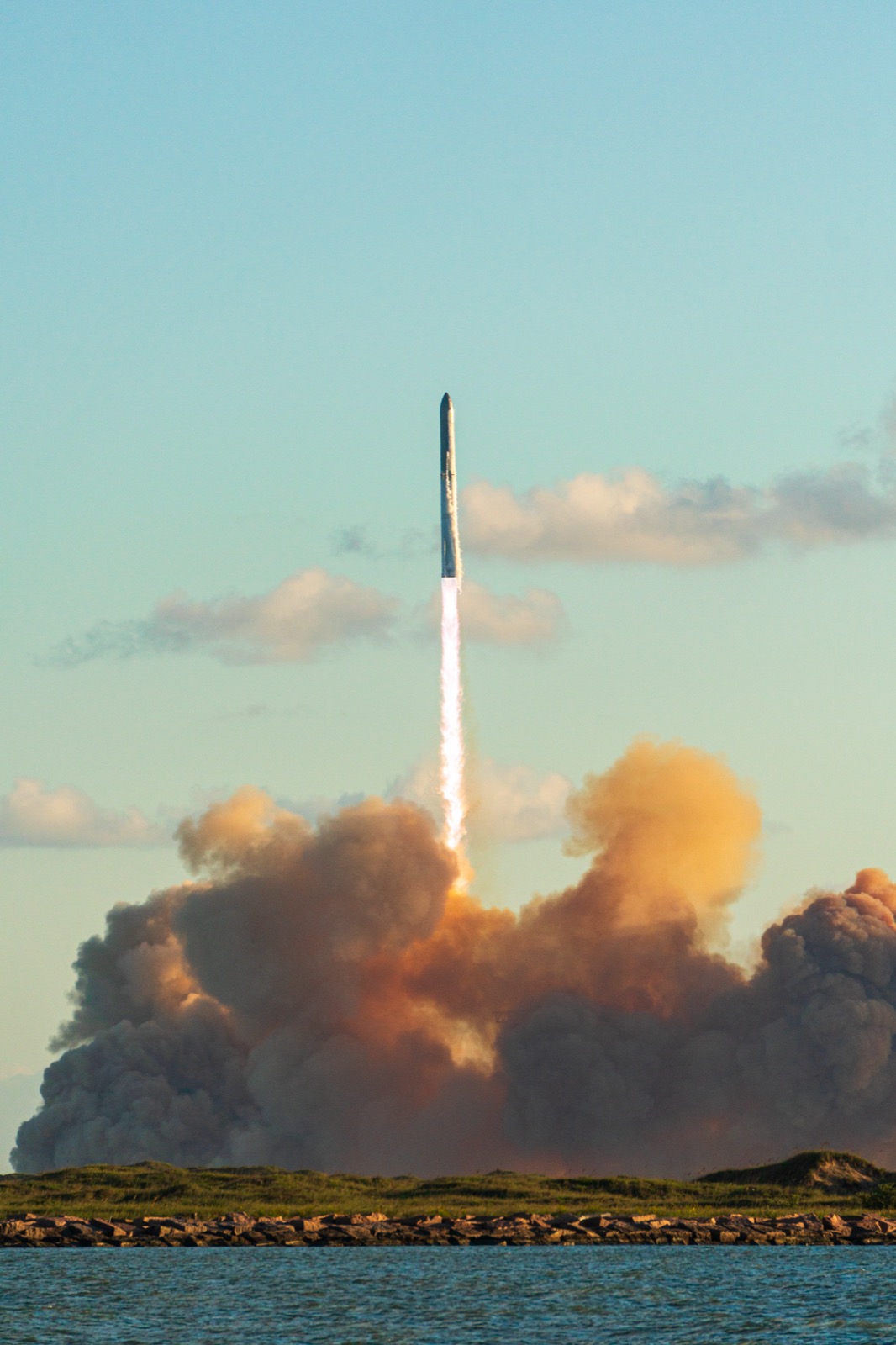
On September 17, SpaceX moved Starship Flight 14 off its earlier NET of Tuesday, September 22. The new public target is as early as Monday, September 28 — still pending regulatory approval. That six-day slip is the calendar news. The systems news is what the flight is supposed to try once the window opens.[1][2]
Flight 14 is planned as Starship’s first sustained orbit attempt and the first operational Starlink V3 deployment — 26 satellites, flown as Starlink Group 31-1. Prior flight tests stayed on intentionally suborbital paths. This profile asks for revolutions, not only a high arc.[3][4]
What Flights 1–13 did not try
Through Flight 13, SpaceX kept Starship on passively safe suborbital trajectories. The point was learning without leaving the vehicle on a path that could stay up if control was lost. Flight 14 keeps that caution in the design: ascent still puts the ship on a suborbital coast first. Orbit is a second decision.[3][5]
SpaceX’s mission materials put the planned altitude near 275 km (about 171 miles) and the flight near ten hours, with roughly six orbits before a Pacific splashdown west of Chile. Peak height alone would not mark the milestone. Completed revolutions would.[2][3]
The ship for this attempt is Ship 41; the booster is Super Heavy Booster 21, from Starbase’s Pad 2 (OLP-2). Neither stage is planned for a tower catch this time.[4]
The health gate before insertion
After ascent and coast, the flight control team must decide whether the hardware needed for a later deorbit burn still has enough redundancy. Only then does Starship fire for orbital insertion. If that check fails, the ship stays on the suborbital path and comes down without the circularization burn.[3]
Orbit is not automatic after a clean ascent. It is gated on whether the vehicle can still leave orbit safely.[3]
SpaceX’s published timeline puts orbital insertion around T+25 minutes, payload deploy starting near T+34 minutes, and deploy complete about an hour after liftoff. Deorbit sits near T+8 hours 52 minutes; splashdown near T+9 hours 50 minutes. Those times are approximate and move with the actual window.[3][4]
The team is allowed to go around the Earth only if they can still come home on purpose.[3]
Booster in the Gulf, ship west of Chile
Super Heavy is planned for a boostback and controlled splashdown in the Gulf of Mexico a few minutes into the flight — landing burn start near T+6:35 on the published clock. No Mechazilla catch on this attempt.[2][4]
Ship 41’s end state is a controlled reentry, flip, and landing burn into the Pacific west of Chile after the orbital work. Engadget and SpaceX’s own profile language agree on that ocean target; Wikipedia’s mission table matches the Gulf / Pacific split.[2][3][4]
Two different splashdowns. One short booster recovery profile. One long ship day.[3]
Twenty-six V3s — and three camera birds
The payload is 26 Starlink V3 satellites intended for the operational constellation — not a demo that burns up with the ship. Engadget notes that an earlier Starship test carried next-generation hardware that only exercised arrays and antennas before atmospheric disposal. Flight 14’s birds are meant to stay.[2][3]
Three of the twenty-six are planned to carry cameras aimed at Ship 41’s heat shield while the stack is still in orbit — extra TPS imagery before reentry. That detail sits in the public mission write-ups Wikipedia draws from SpaceX; treat it as company mission planning, not independent imaging results.[4]
SpaceX states that each V3 adds about 1 Tbps of downlink capacity and that this launch would add roughly ten times the capacity of a Falcon 9 V2-mini ride. Those are company performance claims. They are not Daybreak measurements.[3]
What to check on a slipped NET
As of this draft’s source pass (morning of September 21, America/New_York):[3]
- Calendar voice: @SpaceX’s September 17 post — as early as Monday, September 28, pending regulatory approval.
- Indexed mission-page lead: Google’s snippet for the dedicated Flight 14 page still carried the older “as soon as Tuesday, September 22” language at fetch time. Prefer X over that SERP.
- Launches list / webcast surfaces: SpaceX’s upcoming-launches table and webcast listing already showed September 28 (12:15–13:30 UTC window on the launches list). Cross-check the live page before any publish.
- Window shape (last full public package): ~75 minutes, opening 7:15 a.m. CT / 8:15 a.m. ET — Engadget and the earlier mission-page package; confirm if SpaceX revises the clock with the slip.
- License: Still an open gate day-of. Aviation Week reported FCC clearance among the pending items when the target moved; SpaceX’s own wording stays at “pending regulatory approval” without a public day-of stamp in the sources used here.
Residue
Health-gated insertion. Roughly six revolutions. Operational V3 deploy. A long ship day ending west of Chile. Flights 1–13 did not try that stack. The slip to September 28 moved the earliest public date without answering the license question in public.[3]
Whether Ship 41 is allowed to circularize still depends on that mid-coast health call. The Monday target is the earliest SpaceX will put on the board. It is not yet a cleared countdown.[3]
Sources & further reading
Original reporting and research behind this article.
- @SpaceX, Sep 17, 2026x.com
- Engadget, Mariella Moon, Sep 19, 2026engadget.com
- SpaceX, Starship Flight 14 mission pagespacex.com
- Wikipedia, “Starship flight 14”en.wikipedia.org
- SpaceX updates / orbital-flight framing (passively safe suborbital prior tests; coast health check before circularization)spacex.com
- SpaceX launches listing (Flight 14 shown Sep 28, 2026, 12:15–13:30 GMT)spacex.com
- Aviation Week, Irene Klotz, Sep 18, 2026aviationweek.com
THE DAYBREAK / THE MORNING LETTER
A little more understanding,
every morning.
The day’s selected stories, the context behind them, and a deeper read. A considered start to your day, delivered to your inbox.
See what’s inside