
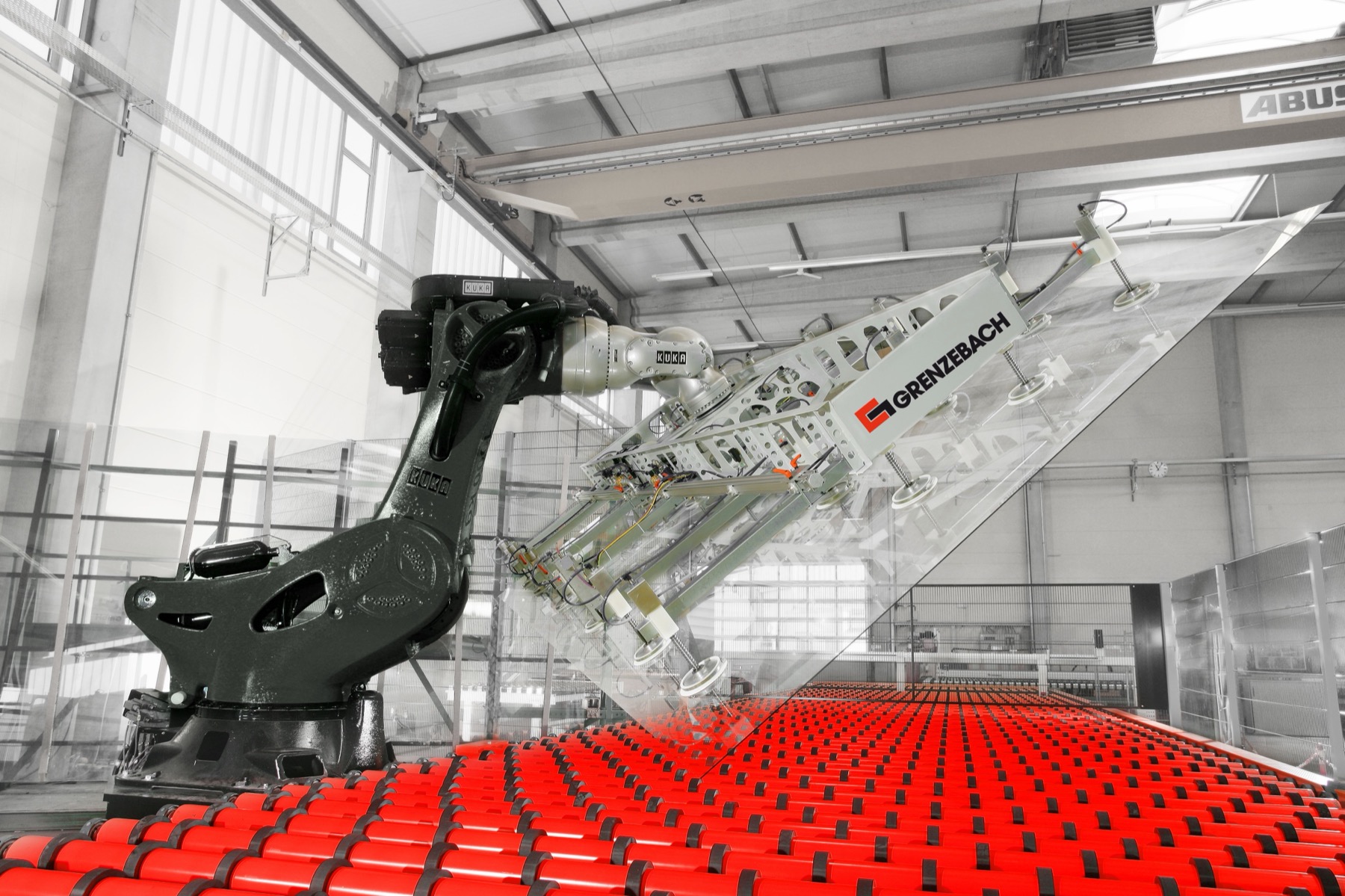
Factories added more than 600,000 industrial robots in 2025, bringing the global operating fleet to an estimated five million. The figures, released September 24 by the International Federation of Robotics, put some scale around a transformation that is often discussed through videos of individual machines. Installations rose 11 percent in a year; the installed fleet grew 9 percent.[1]
Those totals conceal very different investment decisions. China kept adding machines at a scale no other country approached. The United States rebounded. The European Union bought fewer robots while retaining a large installed base. For a manufacturer deciding what to automate next, the global increase is less informative than the particular operation a machine can perform, the equipment around it and the people who will keep it running.[1]
Two deals announced just before the figures appeared address parts of that practical problem. Qualcomm agreed to buy the robotics-software company PickNik; Cognex agreed to acquire the depth-camera business RealSense. Neither transaction is complete. Together, they show investment going into the software that plans movement and the sensing that makes the surrounding world legible to a machine. They are separate developments, not consequences of the new statistics.[8][12]
A manufacturing map with very different speeds
China installed roughly 354,000 industrial robots last year, accounting for 59 percent of the world total. Electronics was its largest customer industry. Automotive and metalworking demand also grew sharply. Yet expansion was uneven even within China: food-and-beverage installations fell 37 percent after an exceptional increase the previous year. A growing national market does not mean every application has found a durable business case.[4]
The United States installed about 38,000 robots, up 12 percent, and overtook Japan as the second-largest national market. Automotive remained its biggest customer, but installations there slipped slightly. Food and beverage grew 30 percent. IFR also notes that most U.S. robots are imported from Japan and Europe, while domestic systems integrators do much of the work of putting automation into use. Buying the arm and building the production system are different economic activities.[5]
In the EU, annual installations fell 11 percent to 60,500. Automotive demand dropped by a quarter; food and beverage increased modestly. At the same time, the region’s operating fleet reached 712,000. That combination is quite possible: a year of weaker purchases does not erase equipment acquired over the previous decade. Germany remained the EU’s largest market, with Italy second.[6]
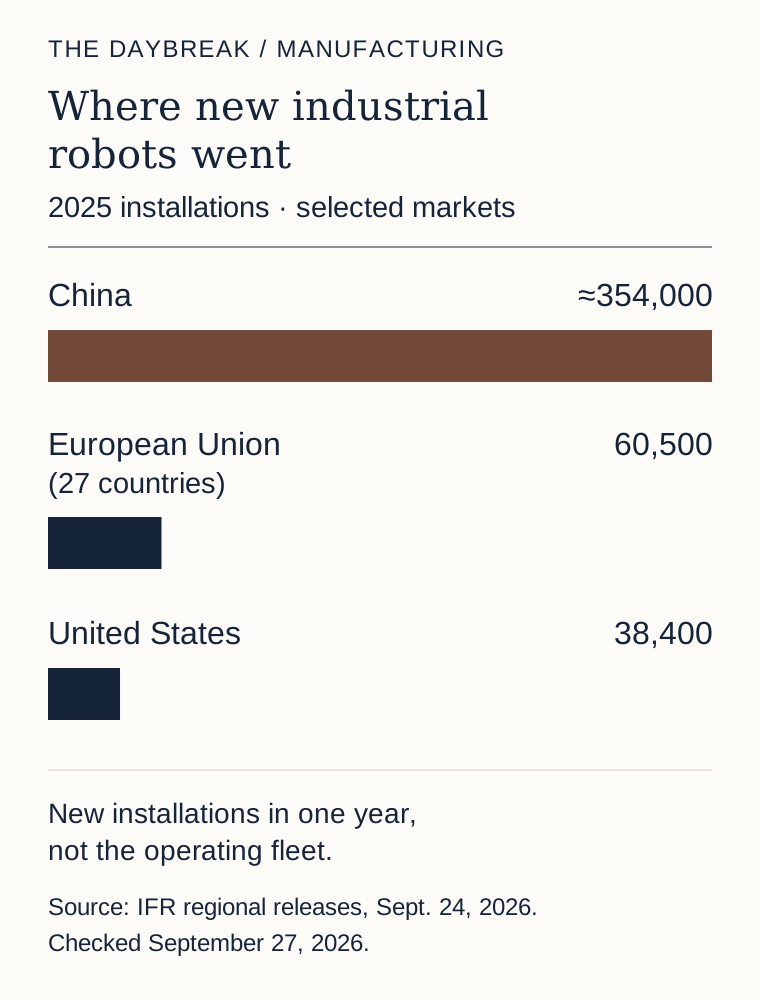
Image details
Original graphic; regional totals rounded as in IFR releases; no source chart reproduced.
What the count can tell us
An industrial robot is a particular kind of machine. IFR’s definition centers on a programmable, multipurpose manipulator with at least three axes of movement. That includes familiar jointed arms and other mechanical arrangements; it does not require legs, a face or a language model. Reprogrammability matters because the same machine can be given different motions rather than being built to repeat only one mechanically fixed action.[2]
The statistics also have practical limits. IFR’s published 2025 methodology accepts shipments when actual installation data are unavailable. A machine can leave its maker in one year and enter service in another. For operational stock outside Japan, the method assumes a 12-year service life and sums installations over that period. Japan supplies its own stock estimate. These conventions make a worldwide series possible, but the result is not a physical inspection of every machine still working.[3]
The federation’s September presentation uses a different approach for service robots. Its figures come from a sample of manufacturers and are not projected to the whole industry; the sample changes between years. A warehouse vehicle, a surgical system and an industrial arm therefore cannot simply be pooled into a single precise measure of how far robotics has advanced.[16]
Teaching a machine to finish the job
A 2021 study by NIST researchers John Horst, Elena Messina and Jeremy Marvel examined how small and medium-sized manufacturers choose workcells for collaborative robots. Their guidance includes production volume, cycle time, quality, task complexity, downtime and the support available after installation. The cheapest or simplest arm is not automatically the best choice. A process with frequent changes may need so much reconfiguration that a technically possible automation project is economically weak.[7]
The study also cautions against reproducing a person’s actions without reconsidering the process. Fixtures, tooling and the way material arrives can change the task the robot must solve. Integration includes infrastructure and staff, not only equipment. A machine’s specifications become useful when they are matched to a particular operation and the conditions under which it must run.[7]
Qualcomm’s September 23 agreement is aimed at that connection between computation and movement. PickNik maintains MoveIt, an open-source framework for robotic manipulation built on ROS, the Robot Operating System. Qualcomm plans closer integration with its Dragonwing robotics platforms and Arduino hardware. It says MoveIt will remain open under its existing license, with community roadmaps and support for other hardware. Those are commitments and development plans, not measured reductions in installation time.[8]
PickNik founder Dave Coleman offered a revealing account of the difficulty in a post the same day. Planning motions could look convincing in simulation, he wrote, while making them run reliably on a real-time controller in production remained hard. His preferred direction combines learned AI models with conventional planning methods. The point is not that an AI model replaces the rest of the control system: the architecture has to make their different strengths work together.[9]
MoveIt’s documentation makes the underlying work tangible. A planner uses a representation of the robot, its current configuration and its surroundings to check possible collisions and constraints. It can test whether an arm would strike itself or something nearby. That digital description is part of the equipment’s ability to move usefully; a command to pick something up does not supply it automatically.[10]
There is a further change once the pick succeeds. MoveIt Pro’s documentation explains how an object is attached to a robot link in the planning scene, so it travels with the gripper in subsequent calculations. Before grasping, the part is an object in the world. After grasping, its size and position help determine where the loaded arm can go. The physical task may sound unchanged, but the planner must reason about a different moving shape.[11]
Buying better sight
Cognex’s September 22 SEC filing puts a financial commitment behind another part of the system. The company agreed to acquire RealSense for about $500 million in cash, subject to adjustments and closing conditions, with completion expected in the fourth quarter. Employee-retention arrangements are additional. The filing explicitly acknowledges that the purchase may not close or deliver its expected benefits.[12]
RealSense supplies depth-sensing cameras and vision technology used across fixed-arm robots, mobile machines and humanoids. Cognex describes the proposed combination as an expansion from its established industrial machine-vision business into robotic perception. Before the deal closes, RealSense’s facial-authentication product line is to be separated into an independent company. This is a defined acquisition of capabilities, rather than a purchase of every product carrying the RealSense name.[13]
Seeing a part well enough to manipulate it is demanding. NIST’s perception research identifies lighting, surface finish, reflectivity and geometry as factors that can affect a vision system. Flexible objects such as belts or cables change shape while they are handled. Transparent objects present another difficulty for systems that depend on imaging their outer surfaces. These are properties of the material and workplace that a robot must deal with, not merely categories to recognize in a photograph.[14]
NIST is developing measurement methods for those problems, including bin picking and vision performance under different lighting. Its work illustrates the distinction between a camera specification and an application result. A factory needs evidence that a sensing-and-software combination can locate the relevant parts under the conditions where it will be used. A supplier’s growth forecast cannot provide that evidence.[14]
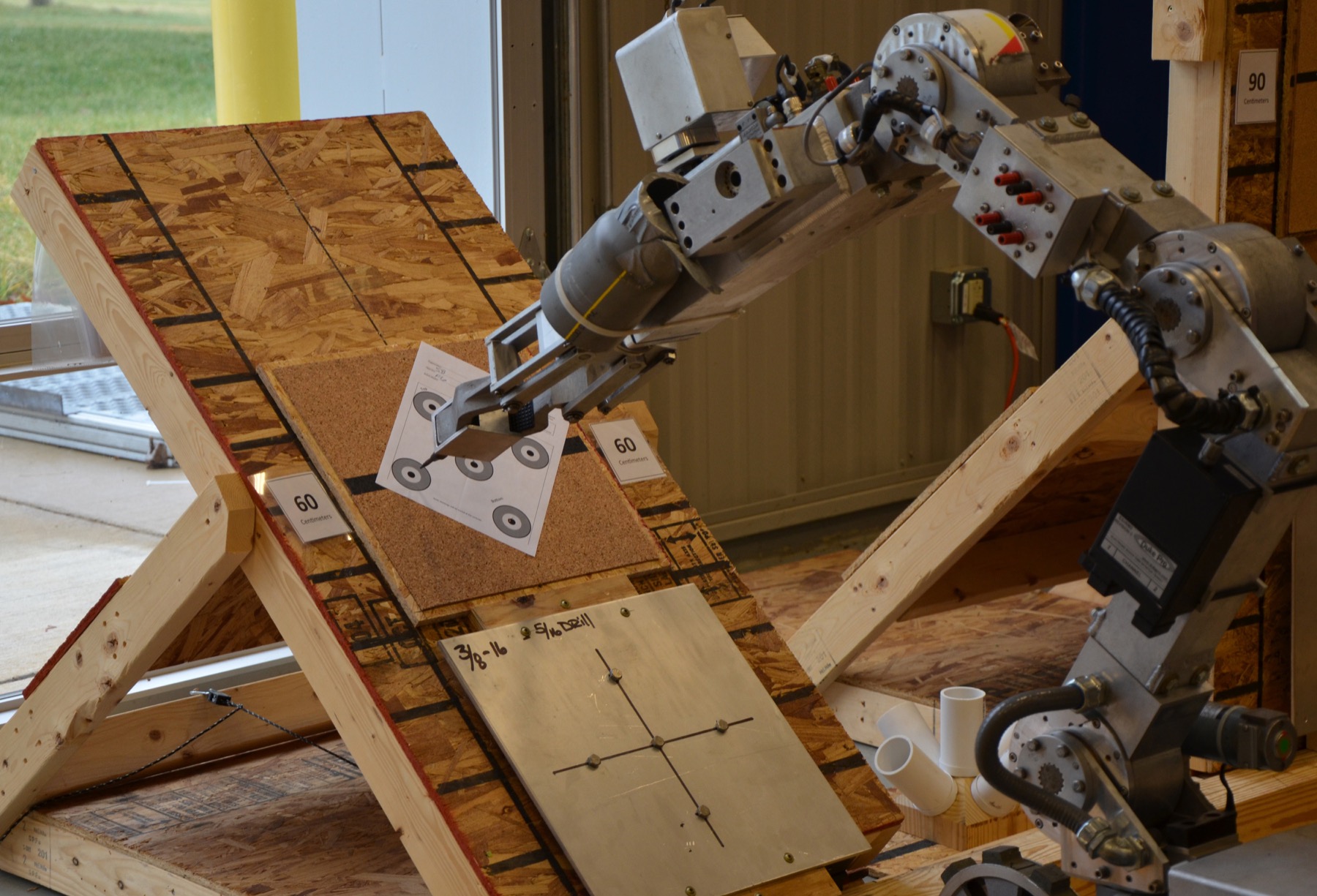
Image details
Original image; no generative alteration. Proportionally resized for publication; original license retained.
Safety adds another system-level test. OSHA’s technical manual treats the complete robot application as including tooling, sensors, protective measures, controls and fixtures. Risks can arise during setup, maintenance and troubleshooting as well as ordinary operation. A robot that appears gentle can carry a hazardous tool or workpiece; errors in surrounding equipment can produce unexpected actions. The relevant unit is the installed application, with the people who enter its space, rather than the arm viewed in isolation.[15]
Where humanoids fit
The IFR presentation reported nearly 7,000 full-size humanoids sold worldwide in 2025, defining that category as machines taller than 140 centimeters. It also identified reliability, safety, training data and the business case as unresolved challenges. A sale is not evidence that a machine has reached sustained productive use.[16]
Some manufacturers have moved beyond laboratory demonstrations. In a June account of its Spartanburg work with Figure AI, BMW said Figure 02 had inserted sheet-metal parts for welding and supported production of more than 30,000 X3 vehicles over ten months in 2025. That describes participation in one operation, not autonomous construction of complete cars. The automaker then announced a Figure 03 project involving parts sorting for production logistics.[17]
BMW described the next task as taking components from larger containers and placing them in a sequencing trolley, which other transport equipment would carry onward. The example shows a humanoid joining an existing production process. It does not supply a public comparison of total cost, uptime or intervention rate against other ways to perform that job.[17]
The next installation
For smaller manufacturers, even deciding how to evaluate a system can be difficult. NIST’s emerging-technology program focuses on environments with many product types and low volumes, where equipment must be retasked frequently. It is developing ways to assess new tools, including digital twins, while noting that a virtual model’s accuracy and delay need evaluation. A simulation can help test a plan, but confidence depends on how faithfully it represents the real workcell.[19]
Support for adoption is also receiving public funding. On September 15, NIST announced more than $30 million for 12 manufacturing-extension centers in 11 states and Puerto Rico. The awards support technology adoption including robotics, AI, automation and additive manufacturing. They are first-year funding within agreements that can run up to five years, with later funding conditional. They should not be read as $30 million of robot purchases or as proof that participating firms have already automated.[18]
After installation, support becomes part of the machinery’s value. NIST’s workcell study advises manufacturers to establish what maintenance and customer support an integrator includes, and what falls outside the agreement.[7]
Sources & further reading
Original reporting and research behind this article.
- IFR global robot figuresPublished 2026-09-24
- Industrial-robot definitionsUndated reference; checked September 27, 2026
- World Robotics 2025: Sources and methods2025 methodology; checked September 27, 2026
- IFR China reportPublished 2026-09-24
- IFR United States reportPublished 2026-09-24
- IFR European Union reportDocument dated September 24, 2026; filename contains September 14
- NIST workcell integration studyPublished 2021-05-26
- Qualcomm’s PickNik agreementPublished 2026-09-23
- Dave Coleman on MoveIt’s next phasePublished 2026-09-23
- MoveIt planning-scene documentationUndated reference; checked September 27, 2026
- MoveIt Pro: representing objects during a pickUndated reference; checked September 27, 2026
- Cognex acquisition filingPublished 2026-09-22
- Cognex’s RealSense announcementPublished 2026-09-22
- NIST perception researchUndated reference; checked September 27, 2026
- OSHA industrial-robot technical manualUndated reference; checked September 27, 2026
- World Robotics 2026 presentationPublished 2026-09-24
- BMW’s Spartanburg robot projectPublished 2026-06-25
- NIST manufacturing-extension awardsPublished September 15; updated September 18, 2026
- NIST emerging-technology evaluation projectUpdated April 23, 2026; checked September 27
- Glass-handling robot photographPhotograph dated September 24, 2007; uploaded September 9, 2013; accessed September 27, 2026
- NIST drilling-robot photographPublished 2015-01-21
THE DAYBREAK / THE MORNING LETTER
A little more understanding,
every morning.
The day’s selected stories, the context behind them, and a deeper read. A considered start to your day, delivered to your inbox.
See what’s inside