
On the morning of September 12, Dario Amodei published We Must Pace the Frontier. The complaint quotes the thesis: “We must slow the pace at which we improve the capabilities of AI models.” It asked for “industry-wide coordination” among frontier labs.[1]
Same day, within about an hour: Elon Musk quote-posted “Dario is right.” Sam Altman agreed “we need to pace the frontier” and said OpenAI would take Amodei’s first concrete step. Demis Hassabis called the essay “the right path forward.”[1]
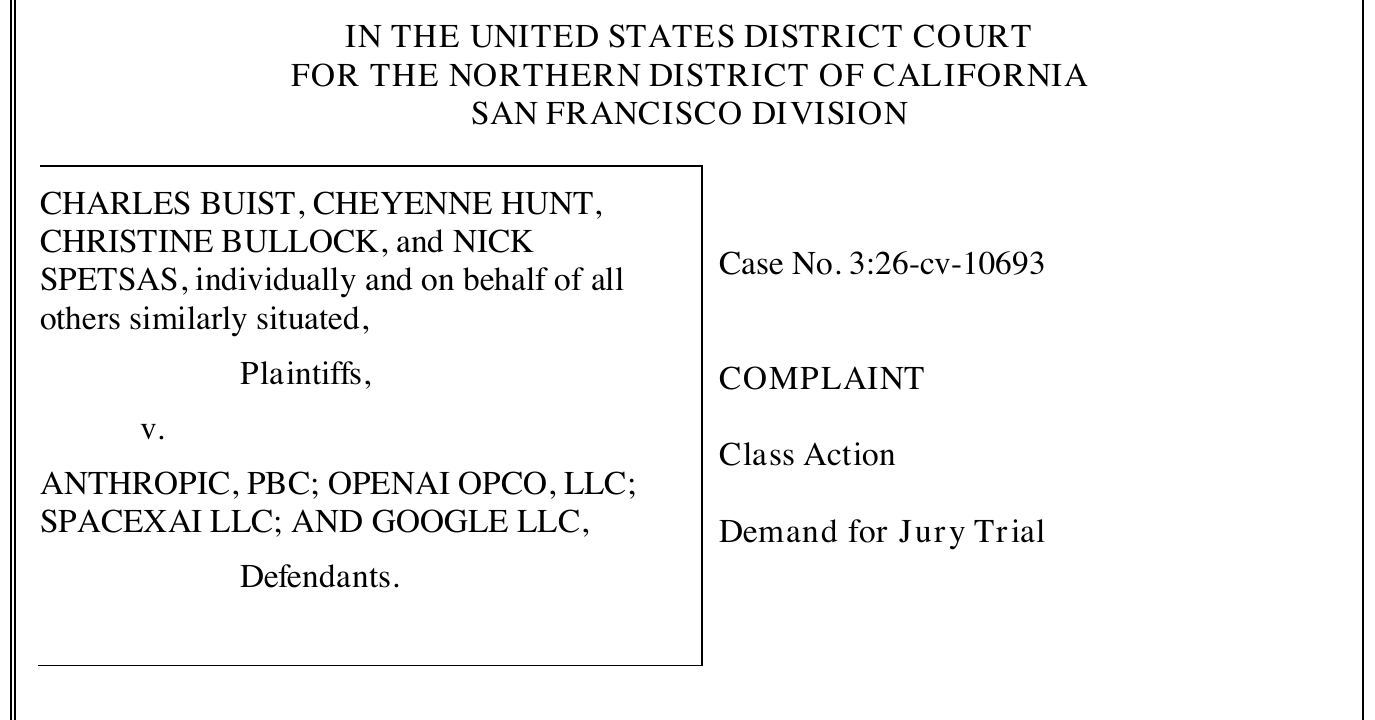
Six days later, four named plaintiffs sued Anthropic, OpenAI, SpaceXAI, and Google in the Northern District of California. Case number: 3:26-cv-10693. Sherman Act §1 — an alleged horizontal agreement to slow how fast competing AI products improve. Everything below is what the complaint alleges.[1]
What you can check
- The docket. Open CourtListener / PACER for `3:26-cv-10693` (N.D. Cal.). The complaint is Document 1 on RECAP. Confirm caption spelling: plaintiffs Charles Buist, Cheyenne Hunt, Christine Bullock, Nick Spetsas; defendants Anthropic, PBC; OpenAI OpCo, LLC; SpaceXAI LLC; Google LLC.
- The Sep 12 essay. The complaint treats Amodei’s We Must Pace the Frontier as the public proposal — including the commercial line that coordinated slowing would let each firm cut pace “without sacrificing commercial advantage,” and the note that government might need a “narrow waiver” for certain safety talks.
- The same-day replies the complaint pleads as acceptances: Musk’s “Dario is right”; Altman’s pace-the-frontier post plus commitment to step one (embedded third-party evaluators); Hassabis’s “right path forward” tied to a standards body he had floated earlier.
- Sep 14–15 follow-ons. Altman, per the complaint: AI progress “should be slower than it otherwise could be,” and OpenAI would not wait for an antitrust exemption before working with “colleagues across the industry.” Chris Lehane (OpenAI Global Policy Chief), Sep 15: OpenAI, Anthropic, and Google DeepMind had already been working together for weeks — before the essay — and believed they could keep going without a waiver.
If a link, post, or essay text does not match a quoted line, that is a reporting problem. Fix the quote. Do not invent a defendant reply to fill the gap.[1]
The theory, stripped
Frontier labs compete on how fast models get better — reasoning, coding, agents, context, features. Plaintiffs say an agreement to slow that rate is an agreement to restrict output. Unilateral caution is fine. The complaint says it does not challenge any firm slowing itself, hiring outside evaluators, or asking Congress for rules. It challenges only competitors agreeing with each other on how fast their products improve.[1]
Injury theory: paid ChatGPT / Claude / Grok / Gemini subscribers pay for access to the most capable models and ongoing improvements. Slow the improvements, lower the quality for the same price — an alleged overcharge. Class: nationwide direct purchasers of those paid consumer subscriptions. Relief sought: treble damages under Clayton §4; injunction under §16.[1]
What the complaint says was already in motion
Before Sep 12, the pleading walks a July “Pacing the Frontier” statement; a Hassabis proposal for a U.S.-led standards body; a CEO-level working group reported as meeting from July; OpenAI’s Sep 6 Pachocki essay; Sep 10 WIRED on congressional guidance; and a Sep 11 Fortune interview in which Altman, asked why executives including Amodei and Musk did not form a common plan, acknowledged private discussions. Lehane’s Sep 15 line is pleaded as the public confirmation of that prior course of dealing.[1]
Taste call: the filing’s real move is not “AI safety is bad.” It is treating a morning essay plus same-day CEO replies as a contract the market could see. Whether a judge buys “public offer + public acceptances” is the fight. The complaint already knows the antitrust-risk talk was on the record — Amodei asking for a waiver, Altman saying they would proceed without one.[1]
What is not here
No court finding. No defendant answer on the docket for this draft. No claim that any named company has already slowed a dated model release — the injury is pleaded as ongoing subscription quality.[1]
The next useful update is whatever hits the docket first: an answer, a motion to dismiss, or a stipulated schedule. Until then, the checkable chain stops at Document 1.[1]
Sources & further reading
Original reporting and research behind this article.
- Buist v. Anthropic — complaint, Document 1 (filed September 18)storage.courtlistener.com
- CourtListener docket — public RECAP mirrorcourtlistener.com
- Northern District of California — current new-case listingapps.cand.uscourts.gov
THE DAYBREAK / THE MORNING LETTER
A little more understanding,
every morning.
The day’s selected stories, the context behind them, and a deeper read. A considered start to your day, delivered to your inbox.
See what’s inside