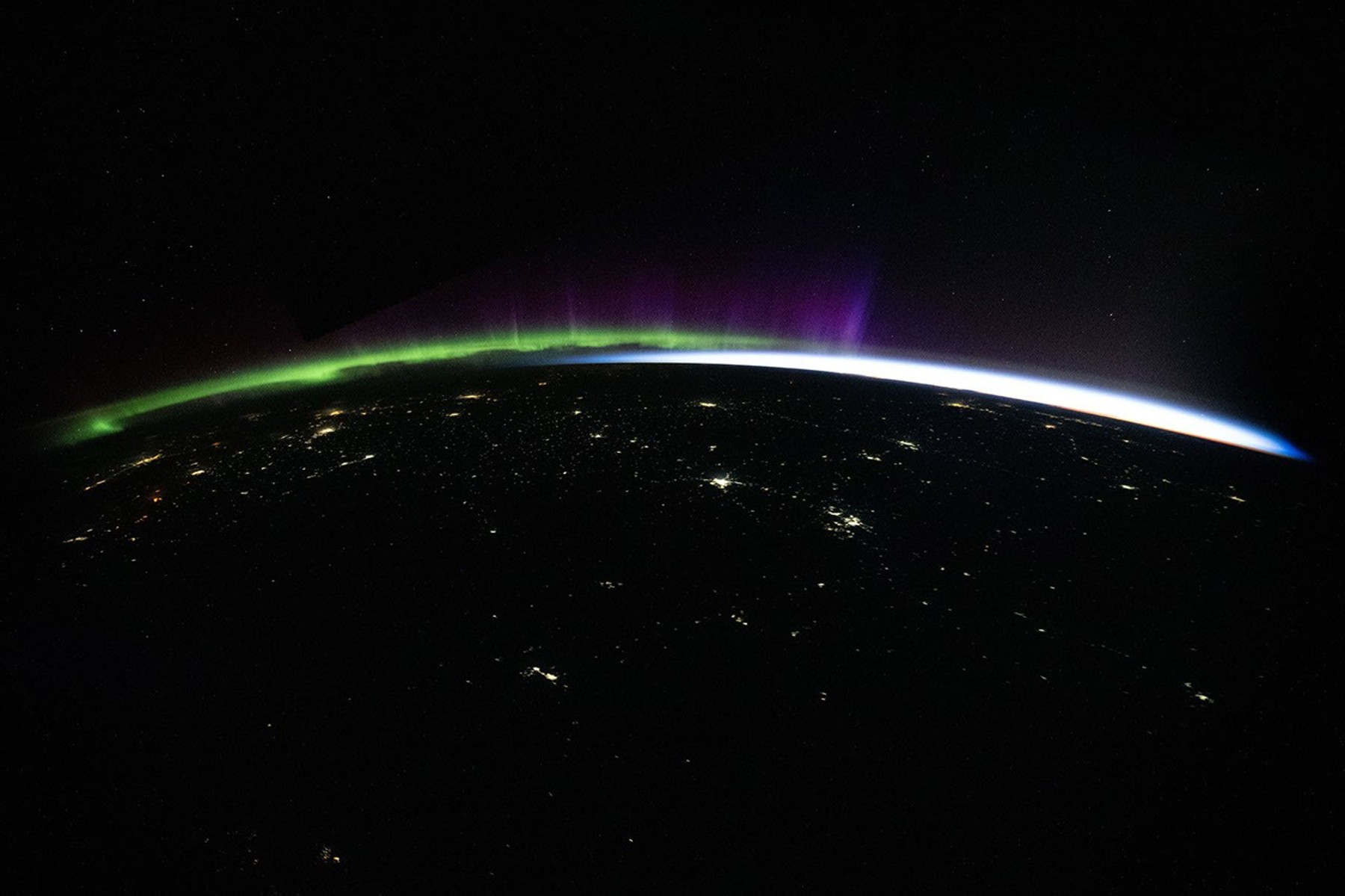
NASA’s Earth Observatory features an aurora photograph today that an International Space Station crew member took on September 7. The station was about 411 kilometers above Kyrgyzstan. A green band follows Earth’s curve beneath a purple glow, with city lights scattered across the dark surface below. This is a view of an earlier event, not a forecast for tonight.[1]
NASA associates the display with minor geomagnetic storm conditions produced by a high-speed stream from a coronal hole, together with lingering effects from several coronal mass ejections. Its published image was cropped and contrast-enhanced, with lens artifacts removed. The photograph is a processed observation of real light, rather than an unaltered proxy for exactly what an eye would have seen.[1]
Color is part of the mechanism
Auroras arise when energy from the solar wind enters Earth’s magnetic environment and is released into the upper atmosphere. Collisions energize atmospheric gases, which emit light as they return toward lower-energy states. The gas involved and the altitude of the interaction help determine the colors.[2]
NASA’s guide associates green light with oxygen roughly 100 to 200 kilometers high and red with oxygen above about 200 kilometers. Nitrogen contributes blue at approximately 100 to 200 kilometers and pink lower down. These are overlapping atmospheric layers, not painted surfaces. Combinations of emissions can produce the purple appearance of a display without requiring a separate purple-producing ingredient.[2]
Seen near Earth’s limb, the layers become especially suggestive: a narrow luminous band appears suspended over a much darker world. Yet the camera is looking through a three-dimensional volume. A color in the finished image can combine light from different places along that line of sight. The photograph supplies structure and perspective; it does not isolate every contributing altitude or particle population.
A fast stream catches slower wind
A coronal hole is a relatively cool, less dense region of the Sun’s outer atmosphere, with magnetic field lines extending outward. It appears dark in extreme-ultraviolet observations; it is not a hole in the Sun’s visible surface. Solar wind can escape more readily along that open field, producing a faster stream.[3]
NOAA explains that when the fast stream catches slower wind ahead of it, the interaction compresses plasma and strengthens the magnetic field. That compressed region can arrive before the fastest part of the stream. Long-lived coronal holes may return to a favorable position over successive solar rotations, creating recurring opportunities for geomagnetic activity. Their existence alone does not specify the timing or severity of an effect at Earth.[3]
This gives the scene a history outside the frame. The visible light is a response near Earth to an interaction that began much farther away. A photograph records one result of that chain. Understanding the chain requires measurements of the source, the intervening solar wind and Earth’s response, each answering a different part of the question.
A beautiful image is not a storm gauge
NOAA uses separate scales for geomagnetic storms, solar radiation storms and radio blackouts. The G1 category cited in NASA’s account is the lowest geomagnetic storm level and corresponds to a planetary Kp index of 5. Radiation and radio-blackout categories measure other phenomena. A striking color or bright-looking band in a photograph cannot be substituted for those measurements.[4]
For an observer, this distinction prevents a common inference: more spectacular-looking photography does not automatically mean more severe operational conditions. Viewpoint, exposure and processing all affect the picture. The relevant operational assessment needs the appropriate observations and products for the phenomenon involved.
Ground magnetometers, radar and all-sky cameras complement orbital views in studying auroras. Together, they help connect changes in the magnetic environment with where and how the atmosphere lights up.[2]
The photograph’s particular contribution is spatial. It makes a thin emitting atmosphere visible against the scale of the planet and places the aurora above the lights of ordinary human activity. That perspective is enough to justify lingering over it. The explanation becomes more useful when the image is allowed to show what it can, without being asked to forecast what comes next.
Sources & further reading
Original reporting and research behind this article.
- NASA Earth Observatory: Purple Haze AuroraSep 16, 2026
- NASA: how auroras form and acquire their colorsReferenced Sep 16, 2026
- NOAA: coronal-hole high-speed streamsSep 25, 2017
- NOAA: space weather scalesReferenced Sep 16, 2026