NASA said Monday that the Nancy Grace Roman Space Telescope could have enough fuel for at least 22 years of science operations. That estimate is a potential lifetime, conditional on the mission’s remaining maneuvers and continued operation. The observatory’s budget covers ten years: a five-year primary mission and a five-year extension.[1]
The immediate gain came from its August 31 course correction, which used about 18 kilograms of propellant against a 200-kilogram allowance. NASA attributes roughly four additional years of potential operation to that saving. Extra fuel carried at launch and expected savings on the remaining transfer maneuvers contribute to the longer estimate. Those later savings have not all been realized.[1]
A fuel reserve creates an option. It does not itself authorize an observing program, pay a science team or ensure that every component will remain healthy. Yet preserving that option early is consequential: a limit that might otherwise have ended a productive observatory’s work has moved farther away. The scientific value will depend on what can be done with the additional time.
A small burn, a long consequence
The first mid-course correction began at 12:02 p.m. Eastern on August 31 and lasted about three minutes. NASA’s maneuver report places it within the transfer to Roman’s observing orbit, rather than the routine scientific operation of the telescope. The mission is still being commissioned.[2]
Roman is traveling toward an orbit around the Sun–Earth second Lagrange point, L2. NASA’s commissioning plan describes roughly three months of travel, during which teams activate systems, make adjustments and calibrate instruments. The location keeps the observatory relatively stable with respect to Earth and the Sun while limiting interference from nearby sources of light and heat.[3]
Relative stability is valuable because an observatory has to keep returning to the conditions under which its measurements can be understood. It also reduces the burden on the spacecraft’s limited resources. But a favorable location is only part of the arrangement; navigation, thermal behavior, pointing and instrument calibration still have to work together.
NASA’s latest schedule calls for another course correction later in September and arrival maneuvers roughly 100 days after launch, in early December. Routine stationkeeping is expected about every 28 days. The long-term fuel estimate therefore remains an engineering projection while the transfer continues.[1]
This is why the distinction between a measured saving and a forecast saving matters. A completed maneuver supplies evidence about actual performance. A future allowance represents an expectation that can be revised. Combining the two is reasonable for planning, provided the resulting date is not mistaken for a guaranteed end of mission.
The instrument behind the reserve
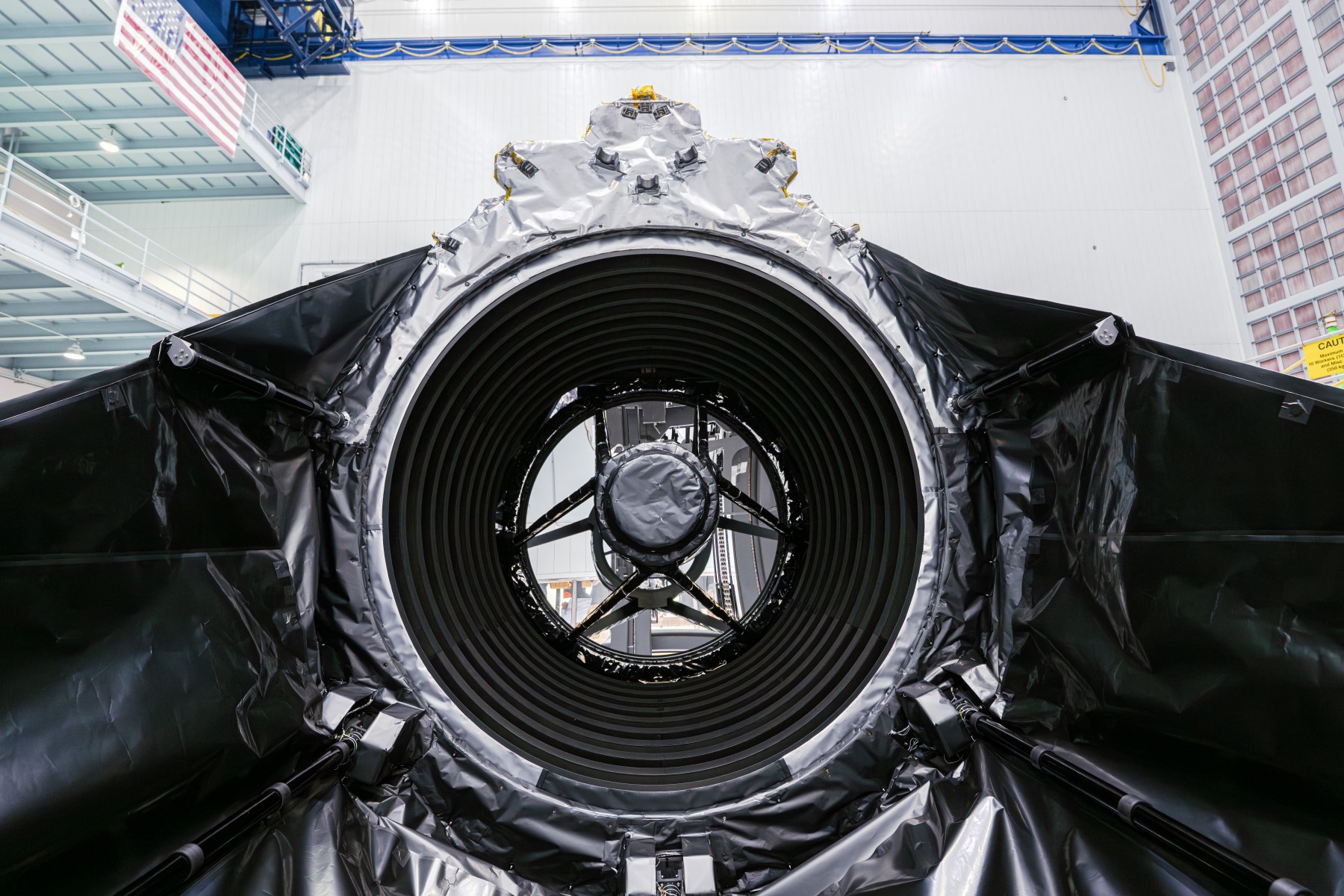
Roman’s two major assemblies were joined at Goddard Space Flight Center in November 2025. Its Wide Field Instrument is a 288-megapixel infrared camera; its separate Coronagraph Instrument is a technology demonstration for observing faint objects close to bright stars. The two instruments give observing time different uses.[4]
The hardware underwent a final close inspection in May after environmental testing. NASA reported that the primary mirror had retained its alignment and cleanliness. Its extremely thin silver coating is optimized for near-infrared light, while the underlying glass is designed to change very little with temperature.[5]
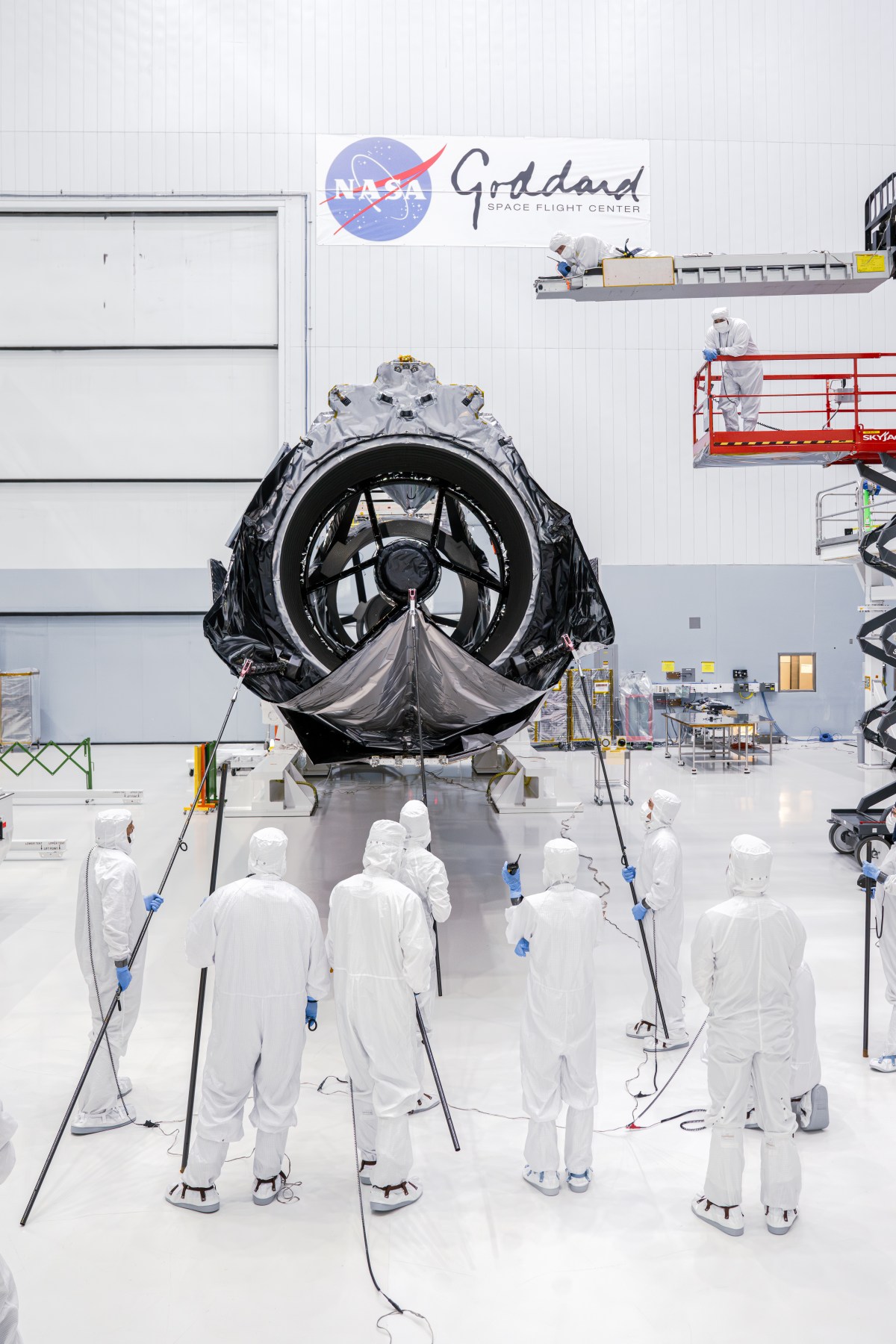
Image details
Resized proportionally; no retouching. Display crops disclosed by the reader.
The photograph shows the other meaning of a long mission: keeping a carefully characterized physical instrument useful after it leaves the laboratory. A larger fuel reserve cannot substitute for that work. It can, however, keep a well-functioning instrument from being retired simply because the spacecraft can no longer maintain its operating orbit.
What another year could contain
Three core surveys are allocated 75 percent of Roman’s primary mission. One maps a broad area of the distant universe; another repeatedly observes the same region to follow changes; a third watches stars toward the Milky Way’s bulge for gravitational microlensing events. The remaining quarter supports other observations selected with the scientific community.[4]
Repeated observation has a different value from simply covering more sky. A second measurement can show that an object changed; a longer sequence can help distinguish a transient event from a recurring pattern. The extension of a calendar baseline can therefore change the questions a dataset can answer, even when the camera and its sensitivity remain the same.
For a wide survey, additional time could instead support a different allocation among area, depth and repeated visits. Those choices compete for observing hours. An extended mission would need a scientific case for how to divide them, rather than assuming that the original plan should merely be replayed. No such decades-long observing allocation was announced with Monday’s fuel update.
NASA describes Roman’s broad scientific aims as measuring the universe’s expansion and the distribution of matter, while extending the census of planets beyond our solar system. Its general-investigator program will allow researchers to propose additional work. Processed data are to become publicly available when delivered to the archive, without an exclusive-use period.[6]
That policy gives a survey a life beyond the first team’s question. A future researcher can test a new explanation against observations already made, or compare them with later observations. Longer operations would expand that common record. Even an unchanged observing strategy could leave a more useful time series for questions that have not yet been formulated.
An early milestone for a second experiment
The coronagraph was powered on September 1. It uses masks, sensors and deformable mirrors to suppress starlight, with the aim of demonstrating direct imaging of planets that are difficult to separate from their host stars. NASA says its calibration will take months; the planned demonstration observations occupy three months spread across the first 18 months of operations.[7]
Power-on establishes that a system has reached an early operating milestone. Scientific performance requires the subsequent calibrations and observations. For the coronagraph, the useful outcome also includes what engineers learn about controlling faint light in space, knowledge that can inform later instruments even apart from the particular objects it observes.
For now, Roman’s next evidence will come from commissioning and the remaining transfer maneuvers. The spacecraft has bought itself room in the fuel account. Whether that becomes a longer survey, more experimental observing time or a different future program will be decided through the performance of the observatory and the scientific case for continuing it.
Sources & further reading
Original reporting and research behind this article.
- NASA: fuel savings and potential mission lifetimeSep 14, 2026
- NASA: first mid-course correctionAug 31, 2026
- NASA: Roman commissioning plan (reference)Referenced Sep 15, 2026
- NASA: observatory construction and survey programDec 4, 2025
- NASA: primary mirror inspectionMay 29, 2026
- NASA: Roman science goals (reference)Referenced Sep 15, 2026
- NASA: coronagraph power-onSep 1, 2026