

Anthropic released Sonnet 5.5 on September 28 with a proposition that reaches beyond programmers: more of the work previously reserved for its expensive Opus model can now be handled by everyday Claude. The company says the new model writes more clearly and handles demanding assignments better. In the Claude app, its default effort setting is medium; developers using the API get high by default. Those settings matter because many of the most impressive results were obtained with the model working much harder. Launch details.[1]
Outside testing supports a substantial advance. Artificial Analysis measured Sonnet 5.5 at 56 on its Intelligence Index at maximum effort, 18 points above Sonnet 5 and two below Opus 5.5. On its Terminal-Bench 4 coding test, the new Sonnet scored 64 percent, against 60 percent for both Opus 5.5 and GPT-6 Astra. These are the evaluator’s runs, separate from Anthropic’s own measurements. The breadth of the improvement makes Sonnet worth examining as a new capability, rather than simply another cheaper route to an existing one. Evaluator’s assessment.[3]
The distinction between a model and its settings is visible in CursorBench 4.0’s coding results. Sonnet 5.5 scored 39.2 percent at medium effort, 47.8 at high and 55.5 at maximum. The older Sonnet 5 reached 34.1 at maximum; Opus 5.5 reached 57.8. A person using the new default app and a developer paying for an exhaustive coding run are therefore drawing on different operating points, even when both say they are using Sonnet 5.5. Current CursorBench results.[4]
A fix that belongs in the codebase
A good coding assistant has to understand what belongs in a change. One public example in Cognition’s FrontierCode evaluation asks for a warning-logging helper: warnings must reach the error stream even when verbose logging is disabled, carry a recognizable prefix and replace the existing warning calls. The assignment sounds small. Completing it requires finding the affected code, preserving behavior, following the project’s conventions and testing the result. A patch can compile and still leave the actual request unfinished. FrontierCode’s task and grading description.[6]
Cognition builds that expectation into its scoring. Its evaluation considers whether a change is ready to merge, including correctness, tests, scope and fit with the codebase. More than 20 maintainers helped develop the tasks, which receive extensive review. That makes the benchmark useful for a question many developers recognize: how much work remains between an AI-generated patch and something a colleague would approve?[6]
Cursor approaches the same problem through work drawn from its own engineering sessions. Its methodology links committed changes with the requests that produced them, then develops evaluation tasks and grading criteria. Real assignments can have several acceptable solutions, so the evaluator cannot simply look for one predetermined patch. It also compares offline evaluations with behavior in the product; a model can satisfy a grader while creating a less useful experience for a developer. Cursor’s methodology.[5]
These are measurements by companies building coding products, with unusually direct access to the work being evaluated. They provide evidence beyond the model maker’s launch presentation. They still cover selected environments and requests.[5]
At maximum effort, the new Sonnet’s Cursor result is close to Opus’s. Cursor warns that small differences may lack statistical significance. The larger change is the distance from the previous Sonnet, which the new model exceeds even at medium effort. That offers a plausible route to better routine assistance without requiring every request to become an extended investigation.[4]
More effort can also produce worse work. Anthropic reports a lower FrontierCode result at maximum than at extra-high effort: 46.2 percent versus 52.1. Its explanation points to excessive review and additional changes in examined cases. A request with a narrow scope can be harmed by an assistant that keeps finding more to do.[1]
The work hidden behind a polished slide
The strongest case for broader use comes from tests that ask for professional deliverables. Artificial Analysis’s AA-Briefcase covers 91 assignments across four private projects, with large collections of source files. The work includes data science, product management and corporate strategy. Sonnet 5.5 at maximum effort scores 1,811 on its comparative scale, against 1,822 for Opus 5.5. Their uncertainty ranges overlap. Sonnet’s medium-effort result is 1,461. Evaluation and results.[7]
Those numbers are ratings, rather than percentages of jobs successfully completed. The evaluation separates required elements, analytical quality and presentation. It also runs each assignment independently. When a later task needs an earlier deliverable, the model receives a standardized reference version, not whatever it happened to produce before. The scores therefore do not establish that an agent can sustain an entire project without accumulating errors.[7]
The public demonstration makes the work more tangible. A fictional private-equity firm is evaluating a fictional New Zealand egg producer. The packet combines real market information with constructed business documents, including contradictions that must be resolved. Its 147 files lead toward a market overview, a spreadsheet model, a target assessment and a briefing video. Producing a convincing-looking deck is only part of the assignment. The analyst has to make the pieces agree. Public task materials.[8]
Even the market categories matter. A grading example distinguishes food-service demand from industrial demand rather than allowing them to disappear into one convenient total. That is a useful illustration of what a reader may miss in a polished AI presentation: an apparently small classification decision can affect the analysis downstream. This public, shorter scenario is not one of the private projects used for the headline score, and it does not describe a real investment transaction.[8]
Much of the judging is itself performed by AI. Artificial Analysis publishes the models and procedures it uses for rubric checks and comparisons, including panels drawn from different model families. Its tool-enabled evaluation provides a working environment in which the assistant can execute code, examine images and submit files. The final artifact matters; promising to prepare it is insufficient. Evaluation methods.[9]
Finding the right evidence is another part of the job. Databricks’ OfficeQA repository shows how difficult that can become: its professional question set draws on hundreds of U.S. Treasury publications stretching across decades. Answers may depend on dense tables, document structure and figures whose meaning changes with context. An assistant that can reason correctly over supplied text may still struggle to locate and extract that text from an archive. OfficeQA materials.[12]
Reading a picture, finishing a task
Some of those demands are visual. Surge’s Chartography evaluation uses specialized charts, including Sankey diagrams, wind roses and engineering plots, rather than relying only on familiar bars and lines. Professionals develop and review the questions. A model must identify the right feature and read a value with precision appropriate to the chart. Thin flows, overlapping curves and multistep reasoning create different opportunities for error. Benchmark design.[10]
This is relevant to the office-work promise because a report often embeds its most important evidence in a figure. An assistant may describe the subject correctly while reading the wrong curve or misjudging its scale. Chartography’s earlier published examples explain the difficulty; their older model rankings should not be treated as a current comparison of Sonnet 5.5. For a consequential figure, the question remains whether the specific visual evidence survives the assistant’s interpretation.[10]
Computer-use testing goes further: the model must operate the applications in which work happens. In the OSWorld long-workflow research, one assignment involves assembling an expense report from a policy document, receipts, bank charges and earlier employee information, attaching the necessary evidence and submitting it. An incoming message can change what is required. The assistant has to retain details, revisit a decision and carry information between applications. OSWorld research.[11]
The researchers designed 108 extended workflows; humans took a median of about an hour and a half to finish them. Their earlier experiments diagnose the difficulties of long tasks, rather than reporting results for this newly released Sonnet. The design also explains why a score needs its denominator. Giving an assistant credit for useful intermediate steps answers a different question from counting how often it satisfies every requirement.[11]
Anthropic’s new system card makes that distinction unusually clear. On OSWorld 2.1, at maximum effort, Sonnet 5.5 earned 80.1 percent with partial credit but completed every checkpoint in 43.5 percent of tasks. Opus 5.5 reached 48.7 percent on that stricter measure; the old Sonnet reached 25.6 percent. These are vendor measurements under the same setup, including a 500-action limit. The improvement is substantial, while reliable completion of every assigned step remains a much harder standard. System card, pages 129–132.[2]
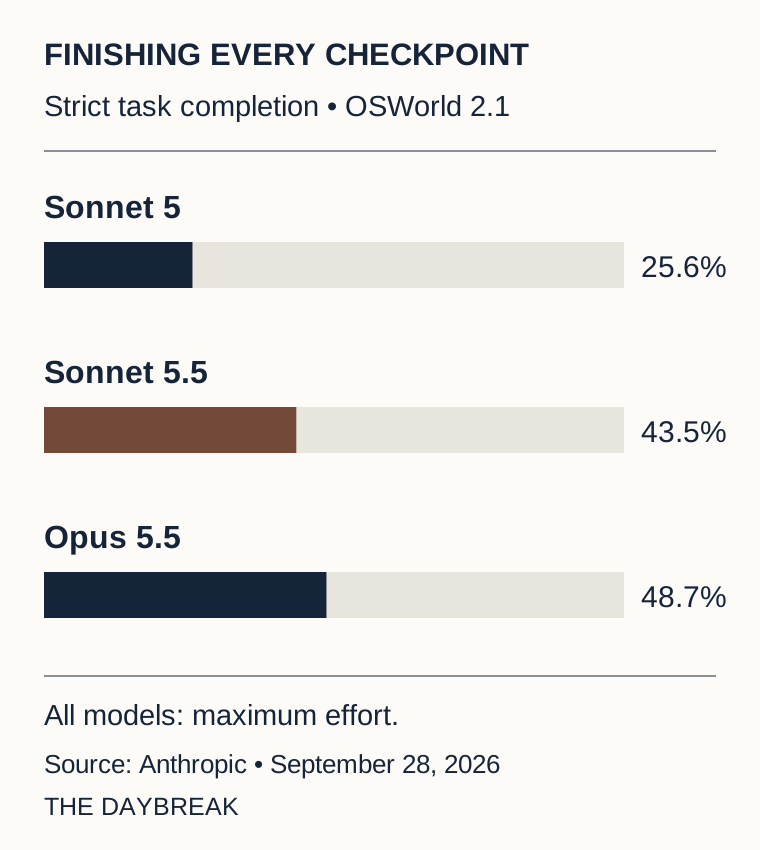
Image details
Original chart from published measurements; no source figure reproduced.
What changes in everyday use
The outside results also have a release-day qualification. Artificial Analysis tested a prerelease deployment affected by a structured-output bug; the evaluator said it would rerun the affected evaluations after the fix. The published scores are the measured results available, not evidence that a subsequent version has already been retested. Its tests also used a limited fallback to an older Sonnet in a small fraction of cases.[3]
Anthropic’s practical guidance is more useful than an instruction to turn every setting up. Effort has been recalibrated, so a familiar label does not necessarily buy the same amount of work as it did in the old model. The company recommends medium for well-defined agentic coding, with high for harder assignments. Lower settings can leave verification undone or stop to ask for guidance; higher settings can initiate additional reviews and related fixes. Prompting guidance.[13]
The implication is to make the assignment’s boundaries explicit. A narrow repair needs a clear stopping point. An open investigation needs room to examine alternatives. If the model must consult a particular document or current source, that requirement should be stated rather than assumed. These are the maker’s recommendations, not results of a Daybreak hands-on trial. They help explain how strong maximum-effort results can coexist with a more restrained default experience.[13]
For people building software around Claude, changing the model name also requires attention to the interface. The new model accepts text and images and produces text. Its documentation lists a one-million-token context window, but that capacity does not guarantee that every detail in a large packet will be used correctly. Some older computer-use tool versions and previous thinking configurations are incompatible with the new release. Model overview.[14]
Even apparent inactivity can change meaning: progress material may now appear in thinking content that an application omits by default. A product that previously displayed a stream of ordinary progress notes may look quiet unless its integration handles the new behavior. That is a deployment detail with a direct effect on users trying to tell whether their assistant is still working.[14]
Other changes target the machinery needed for longer assignments. Anthropic has introduced beta facilities for compressing a conversation when an application chooses and for defining or changing tools partway through a conversation. A long-running assistant can encounter a new kind of work without its developer having to preload every possible tool definition. These are developer features requiring integration, rather than promises that the ordinary Claude app will now complete any extended project. Developer changes.[15]
Sonnet 5.5 brings a meaningful part of Opus-level performance closer to routine use, with especially strong evidence in coding and structured professional assignments. The strongest results belong to carefully specified configurations. They support trying more substantial work with the new model while keeping the finished artifact—the patch, report or completed workflow—as the object of review. The unresolved question is how consistently those gains survive the less orderly files, changing instructions and interrupted work of an ordinary day.
Sources & further reading
Original reporting and research behind this article.
- Anthropic introduces Sonnet 5.5Published 2026-09-28; checked September 29, 2026
- Sonnet 5.5 system cardPublished 2026-09-28; checked September 29, 2026
- Artificial Analysis tests Sonnet 5.5Published 2026-09-28; checked September 29, 2026
- CursorBench 4.0 resultsChecked September 29, 2026
- How Cursor builds its coding evaluationPublished 2026-03-11; checked September 29, 2026
- Cognition’s FrontierCode evaluationChecked September 29, 2026
- Artificial Analysis professional-work evaluationChecked September 29, 2026
- The public AA-Briefcase-Lite assignmentChecked September 29, 2026
- Artificial Analysis evaluation methodologyChecked September 29, 2026
- Chartography’s chart-reading tasksChecked September 29, 2026
- OSWorld long-workflow researchResearch revised July 13, 2026; checked September 29, 2026
- Databricks OfficeQA repositoryChecked September 29, 2026
- Anthropic’s Sonnet 5.5 prompting guidanceChecked September 29, 2026
- Sonnet 5.5 model overviewChecked September 29, 2026
- Sonnet 5.5 developer changesChecked September 29, 2026
- TechCrunch’s Dario Amodei photographPhotographed September 20, 2023; checked September 29, 2026
THE DAYBREAK / THE MORNING LETTER
A little more understanding,
every morning.
The day’s selected stories, the context behind them, and a deeper read. A considered start to your day, delivered to your inbox.
See what’s inside