

OpenAI plans to begin testing visual advertisements during image generation in ChatGPT in the United States later this month. Announced Monday, the format would place clearly labeled advertising separately from the image a person creates. It is an extension of an existing advertising business, with a distinctive setting: people will encounter the commercial message while asking an assistant to make something for them.[1]
The accompanying changes give advertisers more ways to connect an exposure to a later action. OpenAI describes a tracking pixel and a Conversions API through which businesses can report purchases, leads, app installations and sign-ups. Reporting can credit a conversion after someone sees an ad, as well as after a click; the view-through window is one day. Changing the reporting window does not change campaign optimization, the company says. These tools help a business account for activity following its ads. Establishing how much activity the ads actually produced takes a different kind of evidence.[2]
For readers, the immediate distinction is between the assistant’s response and the advertising around it. OpenAI says its advertising system is separate from the chat model and that advertisers cannot pay to influence answers. Its current help page describes paid placements beneath responses, selected using relevance and advertiser bids. It says advertisers receive aggregate viewing and clicking information, not private conversations; a message sent directly to an advertiser is a separate interaction the advertiser can see.[3]
A label has to survive the surrounding experience
Advertising that resembles nearby content presents a familiar problem. The Federal Trade Commission’s guidance on native advertising asks whether people can recognize a commercial message for what it is. A disclosure needs to be noticeable and understandable in the context where it appears. Its proximity, wording, legibility and contrast all matter, including on smaller screens. Applied to an assistant, that provides a useful editorial test: can a person identify the paid placement while concentrating on the answer or image they requested? The guidance predates this announcement and is not a regulatory finding about ChatGPT. It does, however, explain why the presence of an advertising label is only the beginning of evaluating the experience.[6]
The FTC explored that distinction in research conducted in 2014 and 2015 and published in 2017. Participants viewed captured search and news-style pages on desktop and mobile devices. Changes to advertising disclosures improved recognition, but a substantial minority still failed to recognize some advertising. Researchers examined what people said spontaneously and, in parts of the study, where they looked. The report was exploratory: it did not isolate every design change, and interpreting participants’ comments involved judgment. Its results cannot estimate how today’s ChatGPT users will behave. They show why an interface has to be tested with people doing an actual task, rather than assessed solely by checking that a label exists.[7]
Clear disclosure also need not make an advertisement commercially useless. In a field experiment described in a February 2016 research paper, Navdeep Sahni and Harikesh Nair studied more than 200,000 users of a mobile restaurant-search service. The researchers varied sponsorship disclosures and tracked subsequent behavior. They did not find evidence of consumer deception under the formats they studied; exposure could also lead people to seek out a restaurant later through its ordinary listing. This was restaurant search, years before conversational AI became a mass-market product. It supplies a useful counterweight to the assumption that advertising must work by being mistaken for something else. A well-marked placement can still introduce a business that someone later chooses to investigate.[8]
OpenAI’s current eligibility rules limit ads to eligible Free and Go users, excluding its other listed paid plans and people identified as under 18. Turning off ad personalization does not remove advertising or prevent selection based on the current conversation; it stops using additional information such as past chats. Temporary Chats are ad-free. Those are the company’s documented rules, rather than findings from an independent inspection of every interface.[3]
A purchase after an ad is an incomplete answer
The measurement problem is easiest to see through an older experiment at eBay. Researchers Thomas Blake, Chris Nosko and Steven Tadelis examined what happened when the company stopped buying search ads for its own brand name on Yahoo and Microsoft’s search engines, while continuing them on Google as a comparison. Almost all the lost paid-search traffic moved to unpaid search results. Someone already looking for eBay could still find eBay. The experiment found no measurable short-term benefit from those brand-keyword advertisements, despite the apparent value that ordinary purchase attribution could assign to them.[9]
The same research found a more complicated picture for searches without the company’s name. Advertising could reach new or infrequent users, while frequent customers accounted for much of the expense. That distinction matters for any shopping assistant: a placement may introduce an unfamiliar seller, remind someone of a known business, or appear on a journey whose destination was already settled. Recording the eventual purchase does not distinguish these possibilities.[9]
A larger comparison shows how difficult it can be to reconstruct the missing alternative from customer data alone. A paper by Brett Gordon, Florian Zettelmeyer, Neha Bhargava and Dan Chapsky compared observational approaches with 15 randomized Facebook advertising experiments in the United States. It covered 500 million user-experiment observations and 1.6 billion ad impressions. Even with extensive information about people, the observational methods frequently failed to reproduce the experimental estimates. Two authors were affiliated with Northwestern and two with Facebook. The study concerns another platform and period, so it cannot determine the effectiveness of ChatGPT ads. Its relevant finding is methodological: a detailed record of who saw an ad and who bought something can still leave uncertainty about what would have happened without the ad.[10]
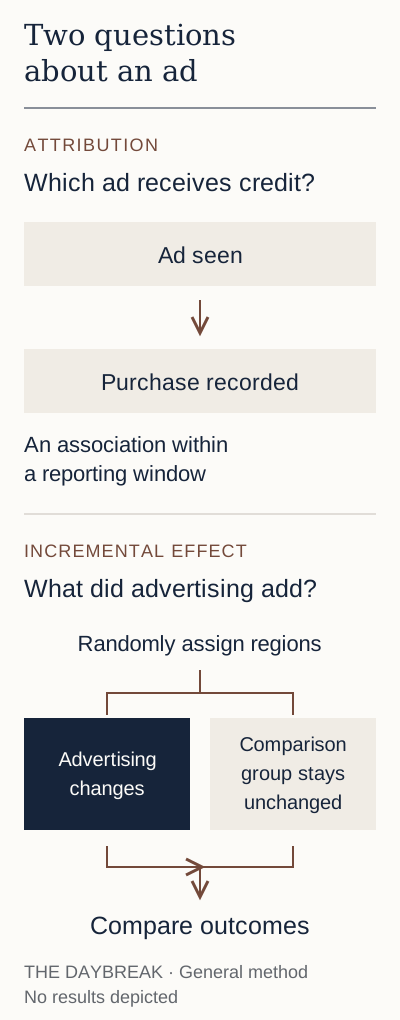
Image details
Original vector diagram of general advertising measurement concepts; no invented results or product interface.
One practical approach changes advertising across randomly assigned geographic regions and compares the outcomes. Google researchers Jon Vaver and Jim Koehler described such experiments in 2011. Regional spending and results need to be tracked; travel between regions, imperfect geographic targeting and delayed responses complicate the comparison. Random assignment strengthens the causal question, but careful execution still matters.[11]
Several controls govern different uses of a conversation
The user’s data choices require similar precision. OpenAI’s data-control documentation separates whether conversations help train models from the controls governing ads. Turning off “Improve the model for everyone” prevents new conversations from being used for training while leaving them in chat history. The setting applies across devices on the account. It does not serve as an advertising opt-out. The documentation also describes an exception when a person chooses to provide feedback: the associated conversation may be used for training. A reader deciding which information to enter therefore needs to know which activity a switch governs. Model improvement, remembered personal context and ad personalization have different controls and effects; changing one should not be understood as changing all three.[4]
Temporary Chat has another distinction that is easy to miss. The current documentation lets people choose a personalized or unpersonalized session before the first message. A personalized Temporary Chat can draw on existing memory, custom instructions and connected plugins, but neither version creates or updates memories. Temporary conversations do not appear in history or train models, although OpenAI says a copy may be kept for up to 30 days for safety purposes. Saving a temporary conversation turns it into an ordinary chat governed by the account’s settings. The temporary label thus describes a particular handling of the session; it does not always mean that the assistant starts without personal context. That choice is now a separate part of the experience.[5]
What the new tests will need to establish
OpenAI’s advertising policies also distinguish what an advertiser may promote from where an ad may appear. The company says ads should not appear near conversations involving sensitive subjects such as personal mental health, emotional reliance or politics. Its rules currently disallow political advocacy advertising, while some regulated categories can be considered subject to additional approval. These distinctions matter when judging the breadth of the policy: a restriction around a sensitive conversation is not necessarily a ban on every business associated with that subject. The published rules describe intended boundaries. Assessing their performance will require evidence of how placements behave across real conversations, including the awkward cases that do not fit neatly into a category.[12]
OpenAI has announced brand-suitability pilots with DoubleVerify and Integral Ad Science in a controlled test environment that excludes private conversations. Those announced pilots do not amount to completed independent audits.[1]
The company also describes early geographic experiments with Haus, Measured and WorkMagic. Such work can address whether a campaign adds business. It cannot, by itself, establish whether people understood the advertising or trusted the surrounding answer. Those questions need their own evidence. As the visual format reaches testing, the useful results will distinguish commercial lift, recognizable sponsorship and the assistant’s behavior instead of treating one successful metric as proof of all three.[2]
Sources & further reading
Original reporting and research behind this article.
- OpenAI announces a new visual ad format and measurement plansSource dated 2026-10-05; checked October 5, 2026
- OpenAI Ads: conversion reporting and experimentsSource dated 2026-10-05; checked October 5, 2026
- OpenAI Help: current ChatGPT ad eligibility, selection and controlschecked October 5, 2026
- OpenAI Help: data controls and model trainingchecked October 5, 2026
- OpenAI Help: Temporary Chat and its personalization choiceschecked October 5, 2026
- FTC: guidance on recognizing native advertisingGuidance published December 2015; checked October 5, 2026
- FTC staff research: advertising recognition in search and native formatsReport published December 2017; checked October 5, 2026
- Sahni and Nair: experimental evidence on advertising disclosureSource dated 2016-02-23; checked October 5, 2026
- Blake, Nosko and Tadelis: paid-search experiments at eBaySource dated 2014-08-12; checked October 5, 2026
- Gordon and coauthors: observational estimates compared with advertising experimentsSource dated 2018-04-12; checked October 5, 2026
- Google researchers Vaver and Koehler: measuring advertising with geographic experimentsResearch paper published 2011; checked October 5, 2026
- OpenAI advertising policies: content and placement restrictionschecked October 5, 2026
- European Commission photograph: attribution and Creative Commons licenseSource dated 2022-12-13; checked October 5, 2026
THE DAYBREAK / THE MORNING LETTER
A little more understanding,
every morning.
The day’s selected stories, the context behind them, and a deeper read. A considered start to your day, delivered to your inbox.
See what’s inside