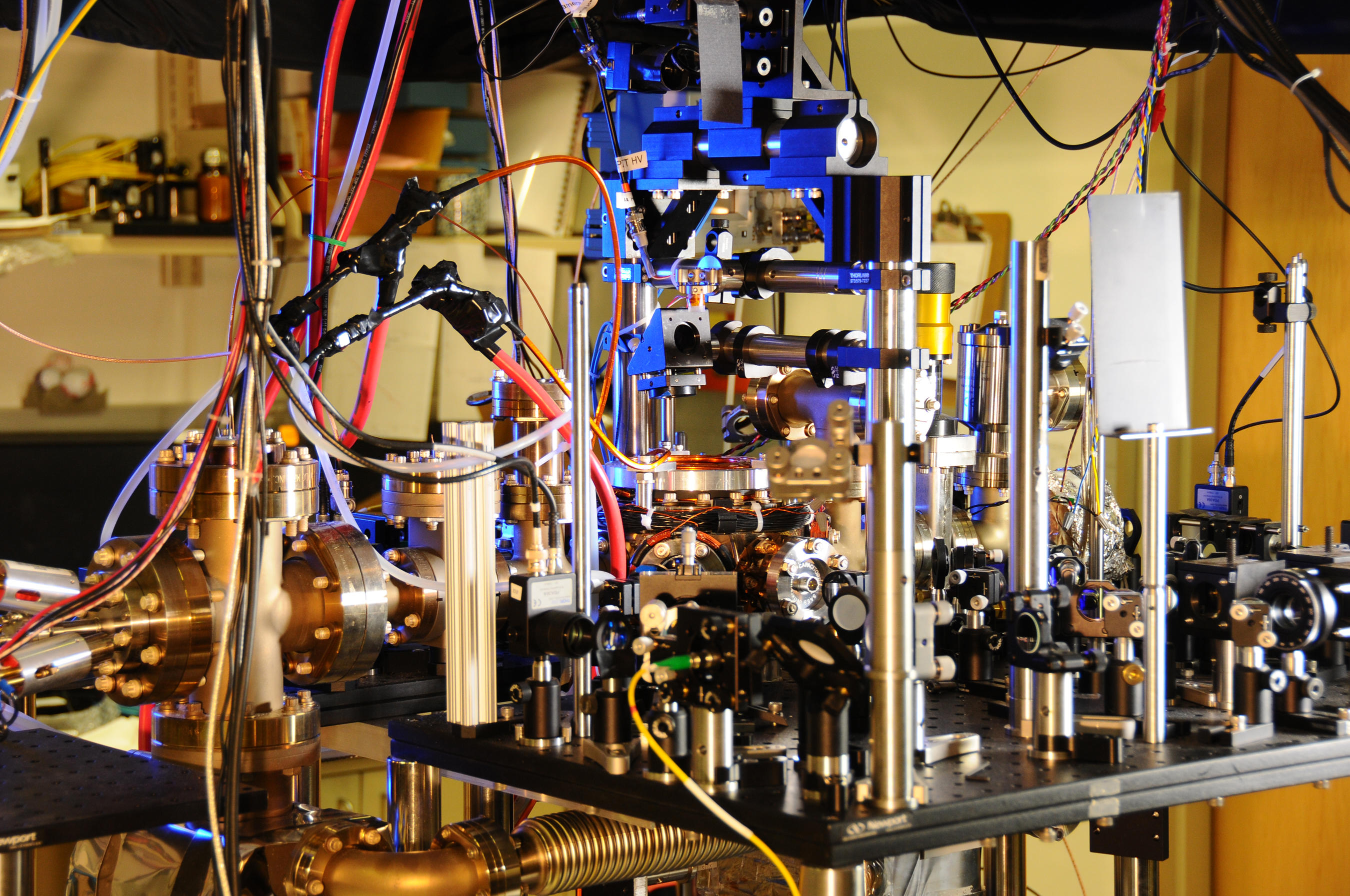
A clock can tell an observer something about where it sits. General relativity predicts that clocks at different gravitational potentials run at different rates. As precision improves, that distinction becomes a measurement tool: a frequency comparison can reveal a difference that ordinary timekeeping was designed to ignore.[2]
In 2022, JILA researchers resolved a gravitational frequency shift across a cloud of ultracold strontium atoms separated vertically by about a millimeter. Rather than putting two independent clocks at different heights, they compared regions of a single sample. The effect was extraordinarily small, on the order of one part in ten to the nineteenth.[1]
The location is part of the measurement
The comparison illustrates a change in what clockmakers need to know. A more precise instrument does not simply supply more digits. It becomes sensitive to influences that a less precise instrument could safely disregard. Location, environment and the way a signal travels between laboratories enter the measurement itself.
NIST’s account of the 2010 experiments described clocks linked by optical fiber and the prospect of applying such comparisons to geodesy. In that setting, time is a route to understanding Earth’s gravitational potential, with potential applications in geophysics and hydrology. A clock is becoming a sensor of its surroundings.[2]
The careful distinction is between geometric height and gravitational potential. A clock comparison responds to the latter. Translating that signal into a useful account of terrain or changes in Earth requires a reference framework and other measurements. It is not a wristwatch that simply reports an altitude.
Precision is not the same as certainty
Two instruments can agree closely while sharing a bias. A clock can also have a stable rhythm while its frequency remains displaced from the desired reference. Progress therefore requires both repeatable comparisons and an accounting of systematic effects. The laboratory achievement is partly the ability to identify and bound what could move the result.
The 2022 experiment used an optical lattice and imaging of the atomic sample to compare frequency across it. NIST reported that extended averaging produced a comparison precision far beyond earlier measurements. The result tested a predicted gravitational effect; it did not by itself establish a new theory connecting gravity with quantum mechanics.[1]
An old relationship, reversed
The connection between time and position has a much older history. John Harrison’s marine timekeepers sought to preserve a reference time during a voyage so that navigators could determine longitude. The Royal Museums Greenwich account shows how much of that work concerned performance under real conditions, repeated trials and the ability of other makers to reproduce an instrument.[3]
The modern clock experiment reverses part of the relationship. Instead of carrying time to infer a position, researchers can compare the passage of time to examine the physical conditions at different positions. In both cases, the instrument only becomes useful when the meaning of its error is understood.
For navigation, this is a familiar discipline taken to a remarkable limit. A measurement becomes trustworthy through calibration, comparison and knowledge of its failure modes. The surprising development is that the imperfections once treated as nuisances can become the signal scientists want to study.
Sources & further reading
Original reporting and research behind this article.
- NIST: relativity measured across a millimeter-scale atom sampleFeb 16, 2022
- NIST: Relativity and Optical ClocksSep 24, 2010
- Royal Museums Greenwich: Harrison’s timekeepersUndated reference; consulted September 12, 2026