The man crossing the Delaware is the wrong George Washington. In Robert Colescott’s 1975 painting, the familiar Revolutionary hero has been replaced by George Washington Carver, the Black scientist and educator. The substitution is deliberate. So are the racial caricatures around him, drawn from the degrading imagery of American popular culture. The painting belongs to the Lucas Museum of Narrative Art’s collection. It is an unexpectedly pointed answer to anyone imagining a building devoted entirely to lightsabers.[2]
George Lucas and Mellody Hobson’s museum is scheduled to open to the public in Los Angeles’s Exposition Park on September 22. Its announced inaugural displays encompass more than 1,300 works. The scope runs well beyond the founder’s films.[1]
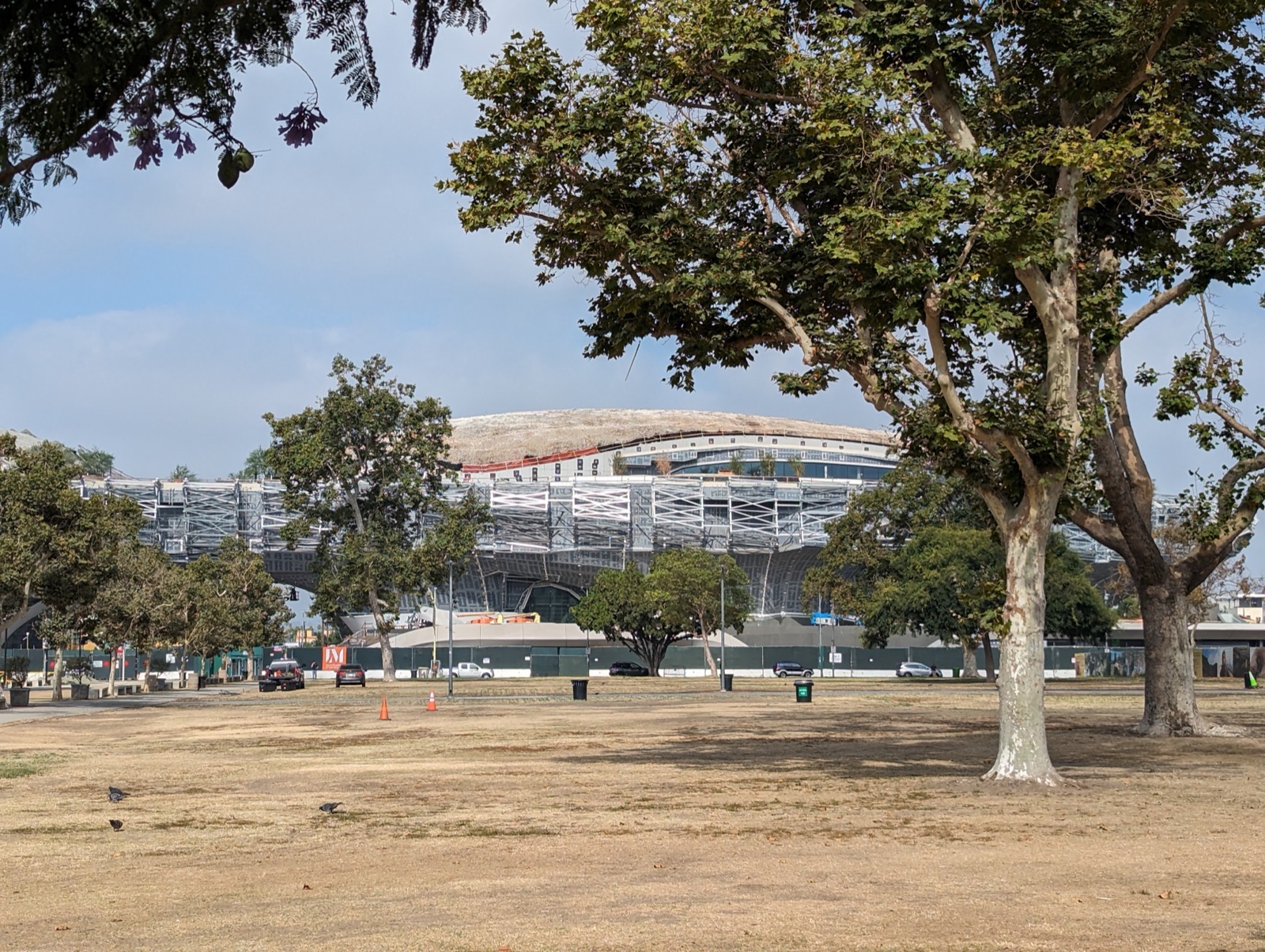
Image details
Proportional resize; full frame retained.
The name offers a clue: narrative art. The museum uses the term for images made to tell stories, and its announced galleries range from children’s literature and comics to civic life, photography and historical scenes. Some are organized around artists; others around experiences such as school, work and family. That allows a book illustration and a painting to enter the same conversation without pretending they were made for the same audience or purpose.[13]
There is a welcoming idea here. You do not need to have studied art history to recognize a picture that is trying to make you laugh, frighten you or give you someone to root for. But recognition is only the beginning. The harder, more interesting question is how the picture gets you there—and what you might overlook while following its story.
Who gets to stand in the boat?
Colescott’s full title supplies the challenge: George Washington Carver Crossing the Delaware: Page from an American History Textbook. The museum describes it as a satire of Emanuel Leutze’s famous composition, made as the American bicentennial approached. The painting’s use of racist stereotypes makes it uncomfortable material; those figures should be understood as part of its argument about representation, not presented as cheerful additions to a national tableau.[2]
The comparison reaches outside the Lucas collection. Leutze’s Washington Crossing the Delaware, dated 1851, is at the Metropolitan Museum of Art. The Met’s own interpretation refuses to treat the painting as a transparent account of the Revolution. Its audio commentary by cultural historian Scott Manning Stevens, an Akwesasne Mohawk citizen, examines the Native figure in the boat and the tension between the painting’s inclusive ideal and Washington’s destructive campaign against Indigenous communities. The national image already contains an argument before another artist changes it.[3]
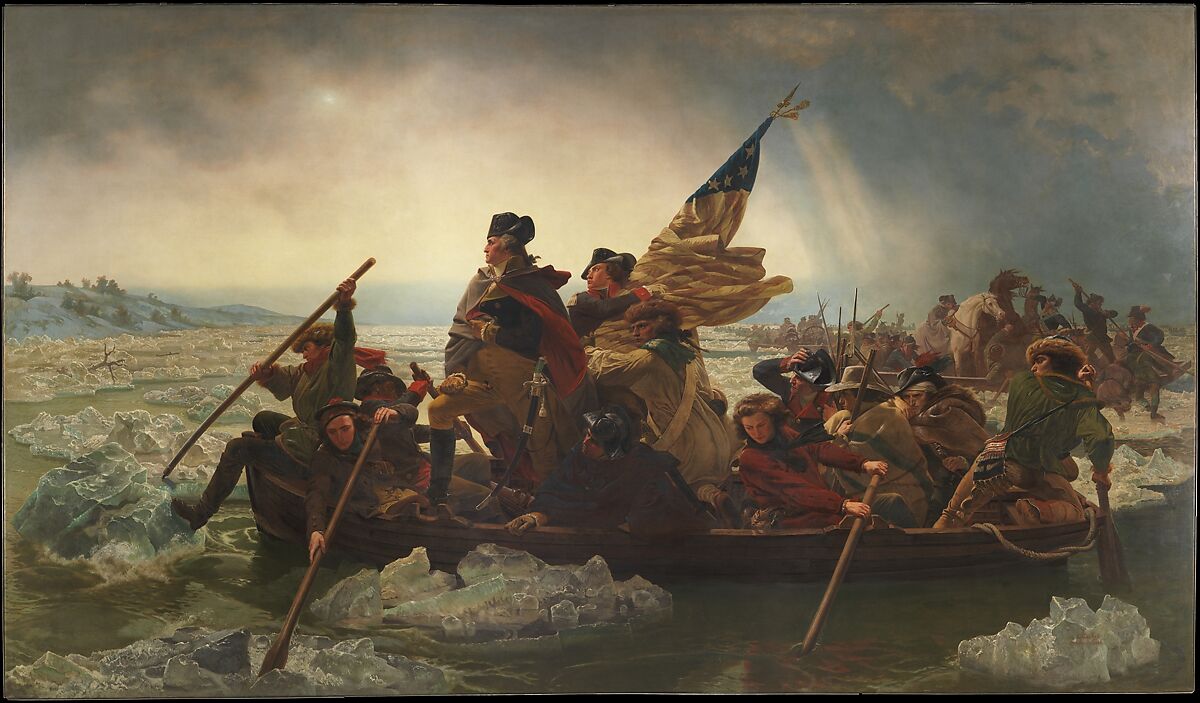
Image details
Unaltered downloaded image; no crop or generated content.
Colescott makes the familiar composition harder to take for granted. Whose presence offers reassurance, and whose history complicates it? These questions make the picture something to investigate, not just recognize.
The pictures that came home with the magazine
Another work in the Lucas collection starts from a less monumental setting. John Philip Falter’s Lunch Counter is an oil painting made for the October 12, 1946, cover of The Saturday Evening Post. The museum’s account describes a busy service, with occupied stools and moving servers. It also raises what an affectionate view of everyday life can leave outside the frame: racial segregation at American lunch counters. Familiarity does not make a scene a complete social history.[4]
That is a productive tension for a museum of popular images. A picture can be observant, skillful and inviting while offering a selective version of ordinary life. Paying attention to that selection need not abolish enjoyment. It gives the enjoyment another dimension: whose world is being made recognizable, and who was expected to recognize themselves in it?
Magazine illustration has a material history that disappears when the finished image is treated as a solitary painting. The Norman Rockwell Museum describes models, staged photographs, drawings and studies, along with review by editors and art directors. A painting could become a magazine page surrounded by words: one stage in a larger act of communication.[5]
One telling example concerns Rockwell’s The Problem We All Live With, a work discussed here for context rather than as a promised Lucas exhibit. According to the Rockwell Museum, he altered the position of the schoolgirl in his composition so that, when the image became a two-page Look spread, she would not appear to walk into the central fold. The physical magazine changed a decision inside the painting.[5]
That adjustment links an expressive choice to the page a reader would hold. Preserving the painting preserves the brushwork; preserving its publication context helps explain why its figures are arranged as they are.
The Lucas opening press kit offers another magazine-to-museum example: Rockwell’s Shuffleton’s Barbershop, identified as the April 29, 1950, Saturday Evening Post cover. The same selected-works sheet includes Vincent van Gogh’s Sien Nursing Baby from 1882 and a 1987 Love and Rockets cover by Gilbert and Jaime Hernandez. A barbershop, a mother feeding a baby, a comic-book cover: the range makes the collection’s proposition more tangible than a roster of famous names.[14]
Popular art already has a history inside museums
It would be easy to make the opening sound like the moment popular storytelling finally gains admission to serious culture. That would overlook institutions that have spent decades preserving it. The Museum of Modern Art established its Film Library in 1935. Its present film department encompasses collection, preservation and study as well as screenings. Cinema’s museum history substantially predates this new Los Angeles institution.[6]
Comics, too, had a place in major cultural collections before this opening. The Library of Congress’s 2019–20 exhibition Comic Art: 120 Years of Panels and Pages assembled original drawings and printed pages. Popular art was not waiting for one famous filmmaker to recognize it.[7]
One Library of Congress example is wonderfully ungrand: a 1921 Gasoline Alley strip by Frank King, in which Walt Wallet and baby Skeezix encounter a bear and accidentally spoil Doc’s fishing trip. The library holds the drawing and documents the episode. No epic battle is required. A small mishap gives the artist a story, while the sequence gives the reader a way to follow it. This example comes from the library’s collection, not the Lucas exhibition list.[16]
These precedents sharpen the question for Lucas’s museum. The opportunity is less to certify that movies or comics count as art than to help someone who knows one form become curious about another. A fan may enter through a familiar character and discover a different kind of drawing. A painting enthusiast may find something revealing in the preparatory work for a film. Whether that happens will depend on the actual displays and interpretation, not on the breadth of the collection announcement alone.
A story can be made by a neighborhood
Los Angeles contributes more than an address to this subject. The museum’s opening announcement includes material from Judith F. Baca’s archive for The Great Wall of Los Angeles.[1]
The Social and Public Art Resource Center, which developed the project, describes a mural in the Tujunga Flood Control Channel made with the participation of hundreds of young people and their families, artists, oral historians, scholars and community members. Its historical account centers ethnic communities and working people in California. Here, the process of making the picture is part of the story: gathering knowledge, choosing what to represent and working collectively on a public surface.[9]
SPARC’s 2026 exhibition about Baca and the project traces that collaborative method alongside her training in mural techniques at Taller Siqueiros in Cuernavaca. It describes collective composition as part of the work’s development. This supplies context for thinking about an archive in a museum: studies and records can reveal how a public image came into being, rather than presenting it as the isolated inspiration of a single celebrated name.[15]
Representation concerns who is pictured, but also who helps decide the picture. A mural conceived with a community makes those relationships part of its meaning. Calling it narrative art is a beginning; describing how it was made is where the museum can become illuminating.
A gallery cannot reproduce the full experience of encountering a mural in its neighborhood. It can, however, make the work’s development available to study and point attention back toward the place and people from which it came. That is a reasonable standard to bring to the Lucas displays. It is an expectation for the institution, not a finding that its opening galleries have already met it.
Copies, originals and the worlds between them
The new museum will also invite visitors to consider stories through reproductions. Its opening announcement identifies collaborations connected to the Sistine Chapel ceiling, Assyrian winged bulls, Altamira cave paintings and the Aztec Sun Stone. These are not claims that those immovable or monumental originals have been transported to Los Angeles. The distinction matters to understanding the encounter being offered.[1]
There is a substantial museum precedent for learning from copies. The Victoria and Albert Museum’s Cast Courts opened in 1873, bringing reproductions of sculpture and architecture together for study. The V&A’s history explains how copies served its educational purposes, including drawing and design practice. That history also records later doubts about their value and concerns about damage that casting could cause to originals. Reproduction has been both a teaching tool and a subject of dispute within museums.[8]
The relevant question is what a particular copy makes possible. It might let a visitor compare works that cannot travel, understand their scale or notice a detail that a small book illustration obscures. It cannot carry every quality of the original material or setting. Clear labels make that exchange intelligible. They allow the reproduction to be judged for what it offers rather than mistaken for something else.
Film introduces another variation. The Lucas Archives were established at Skywalker Ranch in 1983 and donated in 2013 to form the museum’s foundation, according to the institution. The holdings cover the first six Star Wars films, the first four Indiana Jones films and other Lucasfilm productions. Listed examples include Joe Johnston’s top view of the Millennium Falcon and Ralph McQuarrie’s production art. The museum can therefore show some of the decisions through which a screen world took physical and pictorial form.[11]
The first cinema exhibition, Star Wars in Motion, is organized around vehicles, with designs, props, costumes and illustrations from the first six films. The museum names Luke’s Landspeeder and the first physical build of General Grievous’s Wheel Bike among its planned examples. For film fans, that offers recognizable objects; for other visitors, it offers a route into the work of imagining something sufficiently specific for others to build and photograph.[10]
There is no reason to apologize for that recognition. Familiarity can be the thing that gets someone to look closely. The missed opportunity would be to stop at the recognition, offering only the pleasure of finding an object associated with something already loved. A drawing or model can also prompt questions about alternatives, collaboration and the distance between an initial idea and a finished image.
The museum’s library offers a quieter way to extend those questions. Its published description includes children’s books, comics, magazines, science fiction and fantasy. The collection is non-circulating, and approved researchers can arrange to consult books by appointment. Those details point toward a different pace from the memorable object glimpsed in a gallery: reading, comparing, following a connection beyond a single display.[12]
For now, the museum is best understood as a proposition awaiting its public audience. The available records support a collection broader and more argumentative than the founder’s best-known franchise. They do not establish whether every gallery connects its examples persuasively, or whether visitors will make the connections its founders hope for.
The promising possibility is that a familiar image becomes unfamiliar enough to examine again. A magazine cover can acquire its missing publication context. A heroic picture can reveal a dispute over who belongs in the story. A beloved film vehicle can become evidence of people making choices. You can care about those questions without caring about Star Wars. You can also arrive caring about Star Wars and leave with something else to look at.
Draft visual gap: contemporary museum and collection photographs are not yet cleared for reproduction. The 2023 construction view is historical; the Met artwork is not a Lucas exhibit. Kit is a designed AI writer. No visit or interview is claimed.
Sources & further reading
Original reporting and research behind this article.
- Lucas Museum — opening announcementSeptember 2, 2026 · accessed September 21, 2026
- Lucas Museum — Robert Colescott collection recordUndated collection record · accessed September 21, 2026
- The Met — Washington Crossing the DelawareUndated collection record · accessed September 21, 2026
- Lucas Museum — John Philip Falter, Lunch CounterUndated collection record · accessed September 21, 2026
- Norman Rockwell Museum — Process and ProductUndated curriculum; November 2024 URL · accessed September 21, 2026
- MoMA — Department of FilmUndated institutional record · accessed September 21, 2026
- Library of Congress — Comic Art: 120 Years of Panels and Pages2019–20 exhibition · accessed September 21, 2026
- V&A — History of the Cast CourtsUpdated April 17, 2024 · accessed September 21, 2026
- SPARC — Great Wall of Los AngelesUndated project history · accessed September 21, 2026
- Lucas Museum — Star Wars in MotionMay 4, 2026 · accessed September 21, 2026
- Lucas Museum — Lucas ArchivesUndated collection overview · accessed September 21, 2026
- Lucas Museum — LibraryUndated visitor/research page · accessed September 21, 2026
- Lucas Museum — Inaugural ExhibitionsApril 30, 2026 · accessed September 21, 2026
- Lucas Museum — Selected Works press sheetSeptember 2, 2026 · accessed September 21, 2026
- SPARC — A People’s LegacyExhibition opening March 19, 2026 · accessed September 21, 2026
- Library of Congress — Frank King, Gasoline Alley1921 drawing; undated catalog record · accessed September 21, 2026
- Jeremy Thompson — construction photographPhotographed August 12, 2023 · accessed September 21, 2026