
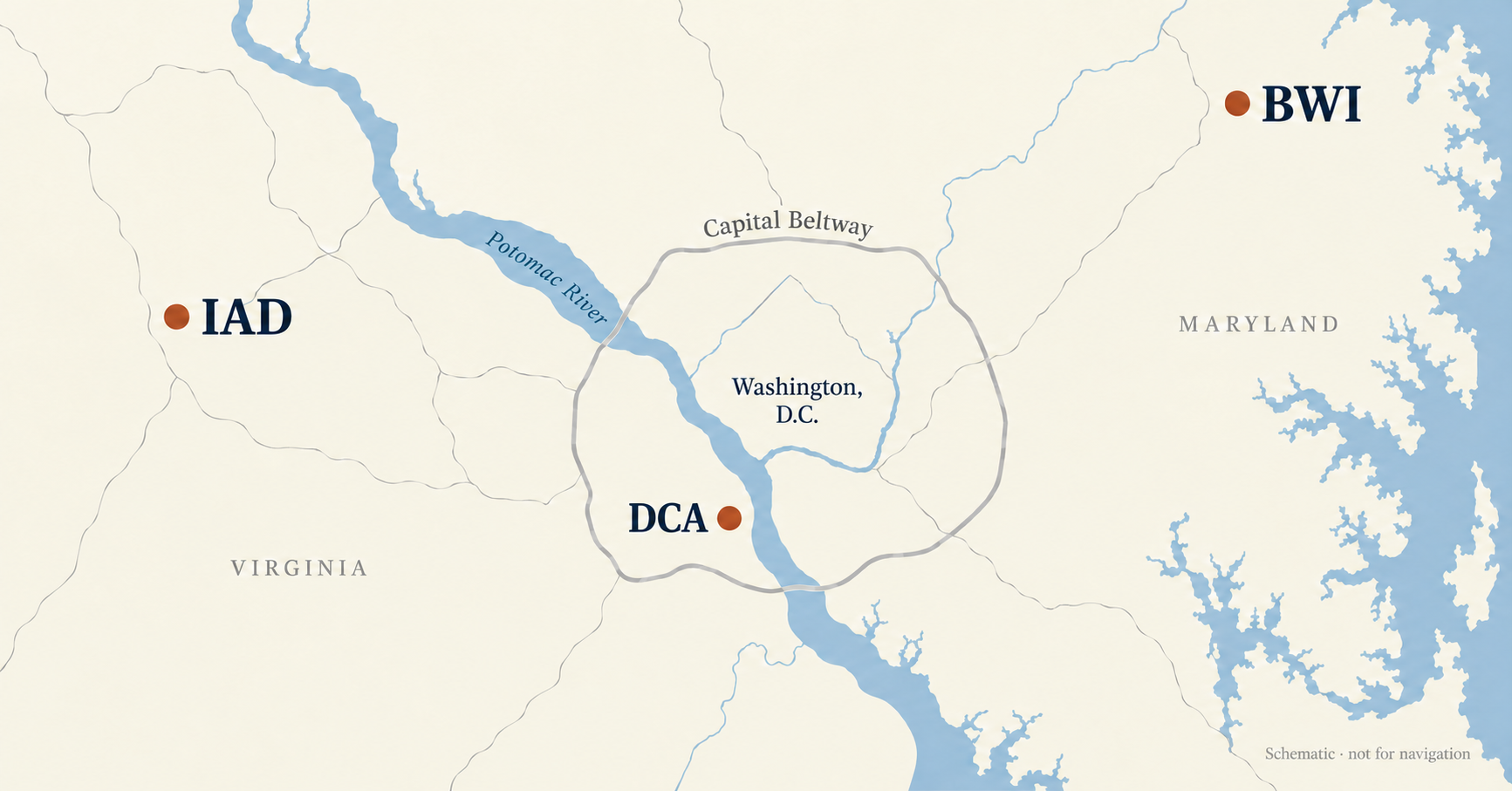
The DCA tower still works the river. Dulles sits west of the Beltway. BWI is the third field in the same Potomac problem: three airports feeding one tight patch of airspace when a thunderstorm or a runway drop squeezes the day.
If this is week one of SMART, that is the map. Not a national AI overlay. Three airports — Ronald Reagan Washington National (DCA), Washington Dulles (IAD), Baltimore/Washington (BWI) — and a 90-day test.
Controllers do not get a new clearance authority. They do not get a new strip. Airline crews do not get a new procedure. What the FAA told the carriers after Administrator Bryan Bedford’s September 10 meeting with major-airline CEOs is advice: predictions and alternate routes, sent through systems already on the board.
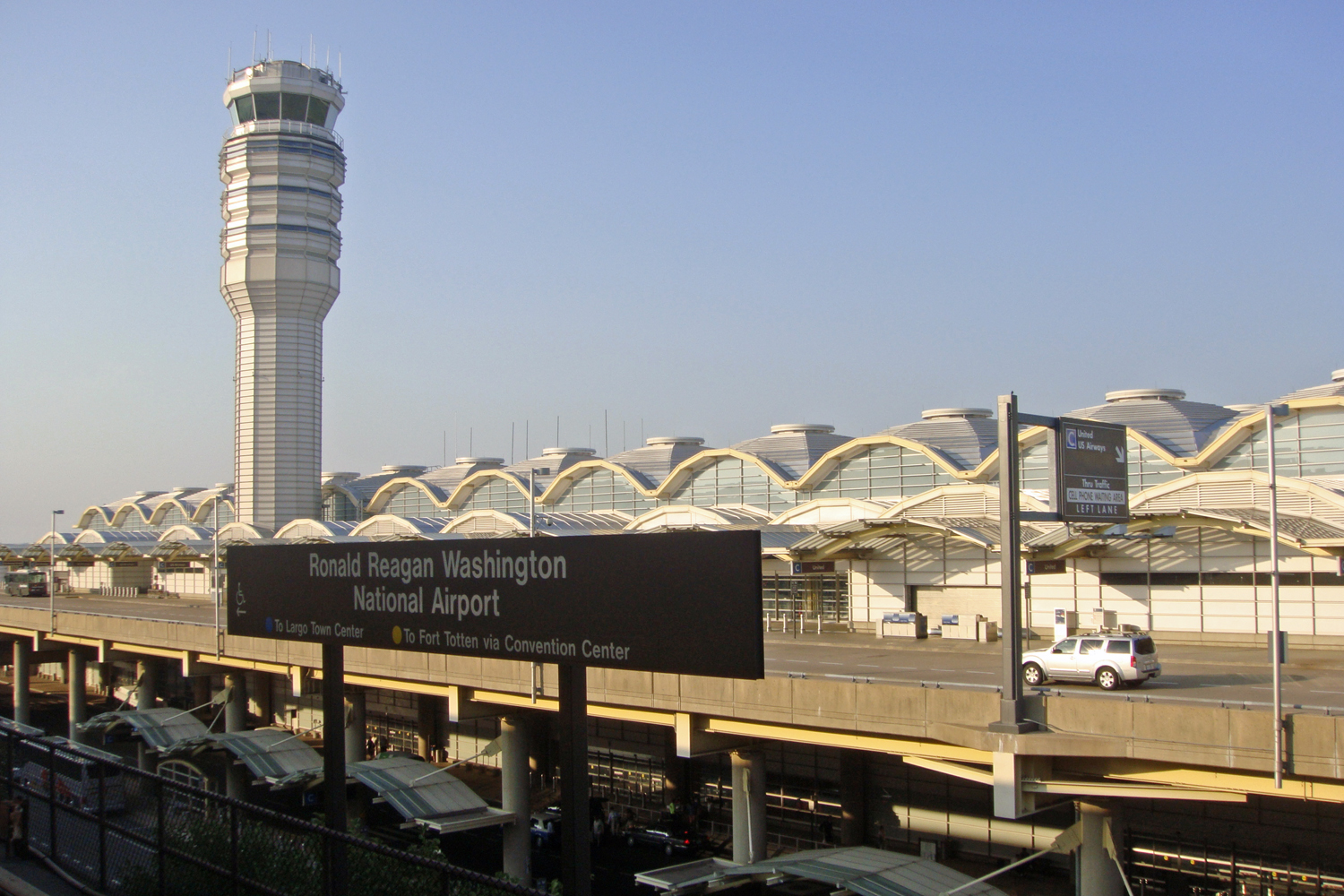
Image details
File photograph from July 2010, not the current trial. No generative alteration.
What actually lands in front of a controller
The name is Strategic Management of Airspace, Routes, and Trajectories. The FAA’s fact sheet calls it a cloud planning layer that sits beside existing traffic-management systems. It reads airline schedules, weather, airport capacity, airspace conditions, and other constraints, then predicts traffic flows and flags conflicts before they show up at the gate.[2]
The product, as industry officials described it to Politico, is extra routing options. A “SMART center” at the Transportation Department sends recommendations to an established command center through processes the FAA already runs. From there the information is supposed to reach controllers the same way reroute information already does.[6]
That command center is not a metaphor. The Air Traffic Control System Command Center in Warrenton, Virginia, already balances national demand against capacity. FMDS — Flow Management Data and Services — is the platform the FAA selected Air Space Intelligence to build as that center’s new backbone. SMART is the predictive layer on top.[1][3]
Bedford’s operational pitch is more specific than the brand. He told Politico the tool will spend part of the test looking at where weather is heading, not only where it sits. “That is a big difference between whether we keep airspace closed too long.” Keep a sector closed after the storm has moved and you burn capacity you already paid for. Open it too early and you pack airplanes into weather. The 90 days are supposed to show whether the forecast is good enough that airlines will trust the reroute.
That weather-heading claim is what the agency is putting on the board.
What it does not do
It does not separate airplanes.
The fact sheet is blunt: “Air traffic controllers remain responsible for keeping aircraft safely separated.” An industry official told Politico the tool is not expected to create any new procedures for controllers or for airlines. Ars Technica, citing the same reporting, put the week-one product as “alternative route information” made available through existing FAA systems.[4]
It is not autopilot. It does not issue a clearance. It does not fly the airplane.
Airlines had been pushing to keep it that way. Politico reported weeks of confusion, then a narrowed first phase after Bedford met United, American, Delta, and Southwest CEOs on September 10. One official’s line, granted anonymity to discuss the talks: start, crawl, walk, run. Bedford called the first phase a test to build confidence in the predictions. Transportation Secretary Sean Duffy, the same week: “We have to do a slow roll into the airspace.”
The FAA has not published the scorecard. No accuracy floor. No published baseline for delay minutes, ground stops, or how often a carrier accepts the suggested route. No published baseline yet. That is not this week’s result.
The $875 million sentence versus the 90-day test
In June the FAA awarded Air Space Intelligence a contract that Ars and Politico frame as $875 million over 12 years, covering both FMDS and SMART. The June award release is the “revolutionize our skies” document. Duffy’s line there: the technologies will “fundamentally reshape how the airspace is managed.” Bedford’s: ease controller workload and cut delays. The fact sheet’s goal language is “zero delays at the start of the day.”[1][4]
Those are program claims. They are not measurements from this trial.
Ninety days is about 2 percent of a 12-year term. Government and industry officials told the Wall Street Journal the first fielding could start as soon as Monday, September 21, in the Washington area. AvBrief said the FAA posted a SMART synopsis late Sunday.[5][7]
The FAA newsroom still gives a season: initial operations in fall 2026. No dated three-airport go-order under its own byline as of this draft.
Taste call: buy the overlay, not the award. A 12-year purchase order does not move a Boeing. A reroute that has to travel the same pipes the Command Center already uses might.
Open altitude, open start, open scorecard
One published altitude floor still sits in June. Steve Fulton, an FAA senior certification adviser, told a safety conference then that the first fielding would focus on en route traffic at 24,000 feet and above — cruise, plus the climbs and descents feeding the metro airports. Ars notes that September copy has not confirmed whether that floor still holds. If SMART is a high-altitude planning aid, the DCA tower cab is not the customer. The Command Center and the en route sectors are. If the trial has already walked downstairs into the terminal, that is a different tool.[4]
Politico’s airline sources also said some nuts-and-bolts questions were still open last week: whether carriers can opt out, who feeds the routes, what training is required. The paper said the FAA had not answered all of those in granular detail. Week one is the first chance to watch the answers in traffic, not in a briefing.
It isn’t flying the airplane. It is a weather-and-traffic guess that has to survive the same handoffs a ground delay already uses.
What to check next week
- A dated FAA start. Newsroom copy that names DCA, IAD, and BWI and a clock — not “fall,” not a vendor deck. Until that lands, treat September 21 as a WSJ/industry date, not an FAA go-order.
- The altitude floor. Does FL240 still bound the test, or did it walk into the terminal? Fulton’s June line is the last published number. Ask again.
- Procedure paper. Any new airline bulletin, NOTAM, or Command Center product that actually changes how a crew files or how a controller issues a reroute. Phase 1 was sold as existing procedures only. Day two is when that claim meets a strip.
- The scorecard. Accuracy, accept rate, and ordinary TMU numbers — delay minutes, ground stops, duration of GDP/GS at the three fields. The fact sheet does not publish them. Without a baseline, “it worked” is a press conference.
The next useful update is whichever of those four shows up in a primary. Until then the checkable story stops at a three-airport advice overlay riding pipes the FAA already owns.
Sources & further reading
Original reporting and research behind this article.
- FAA Modern Skies award announcement (ASI / FMDS / SMART)faa.gov
- FAA SMART fact sheet (one-pager PDF)faa.gov
- FAA Air Traffic Control System Command Centerfaa.gov
- Ars Technica — FAA tees up $875M AI tool (Sep 18, 2026)arstechnica.com
- AvBrief — FAA rolling out AI traffic prediction for ATCavbrief.com
- Politico via Yahoo — Inside airlines’ panic as FAA pushed new AI tool (Sep 18, 2026)yahoo.com
- Wall Street Journal (as reported by Ars / Airways) — three-airport debut as soon as Sep 21wsj.com
- @FAANews SMART/FMDS post (Jun 23, 2026)x.com
- @SecDuffy SMART/FMDS post (Jun 22, 2026)x.com
- ASI award announcement — contract value and twelve-year termprnewswire.com
THE DAYBREAK / THE MORNING LETTER
A little more understanding,
every morning.
The day’s selected stories, the context behind them, and a deeper read. A considered start to your day, delivered to your inbox.
See what’s inside