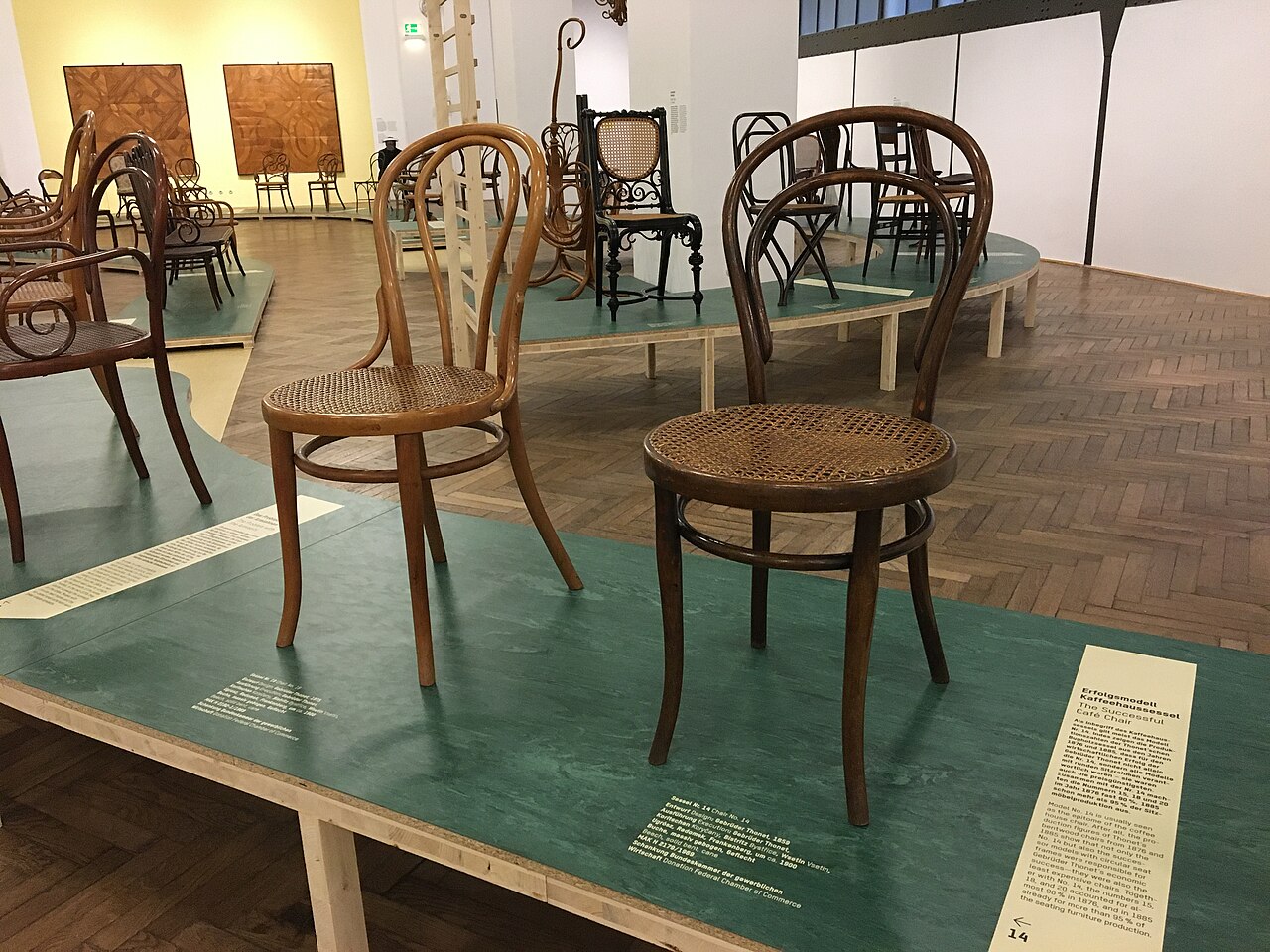
The Thonet chair now known as the 214 was designed by Michael Thonet in 1859. The company’s account of its development highlights a detail that is easy to miss in a museum: 36 disassembled chairs could fit into a one-cubic-meter shipping crate. They were assembled after reaching their destination.[1]
Bentwood construction supplied the recognizable form, but compact distribution helped turn that form into a widely available product. The design addressed production and shipping together. Its economy existed partly in the space that an assembled chair would otherwise occupy.[1]
The shipping crate changes the way the chair should be judged. A photograph of a finished object hides the volume of air it occupies, the parts that can be separated and the labor required at its destination. Here, the route to the café was part of the design problem. The chair’s familiar silhouette was also a system for getting that silhouette into many rooms.
A process that could travel too
Cooper Hewitt’s account of a Catskill rocking chair from around 1900 supplies a useful counterpart to the manufacturer’s history. Bentwood offered strength and flexibility, and steam or hot water allowed softened wood to be shaped with a press. The museum notes that small makers could emulate and elaborate on the mass-produced forms. Its example retains conspicuous chip-carving, the trace of an individual maker inside a broader industrial fashion.[2]
This is a more interesting story than a clean replacement of handwork by machinery. A successful technique can spread through workshops of different sizes and produce objects with different priorities. Repeatable components may make a chair easier to distribute; ornament may help another maker distinguish a related form. The industrial method and the decorative impulse can coexist.
A side chair in the Metropolitan Museum’s collection makes that coexistence visible. Dated to about 1875 and attributed to New York’s Pottier and Stymus Manufacturing Company, it combines Egyptian and Neoclassical decoration with a form the museum compares to Thonet’s bentwood café chairs. Its upholstery and ornament belong to a different setting from the spare coffee-house seat. The attribution is qualified, and the chair is not itself a Thonet No. 14.[3]
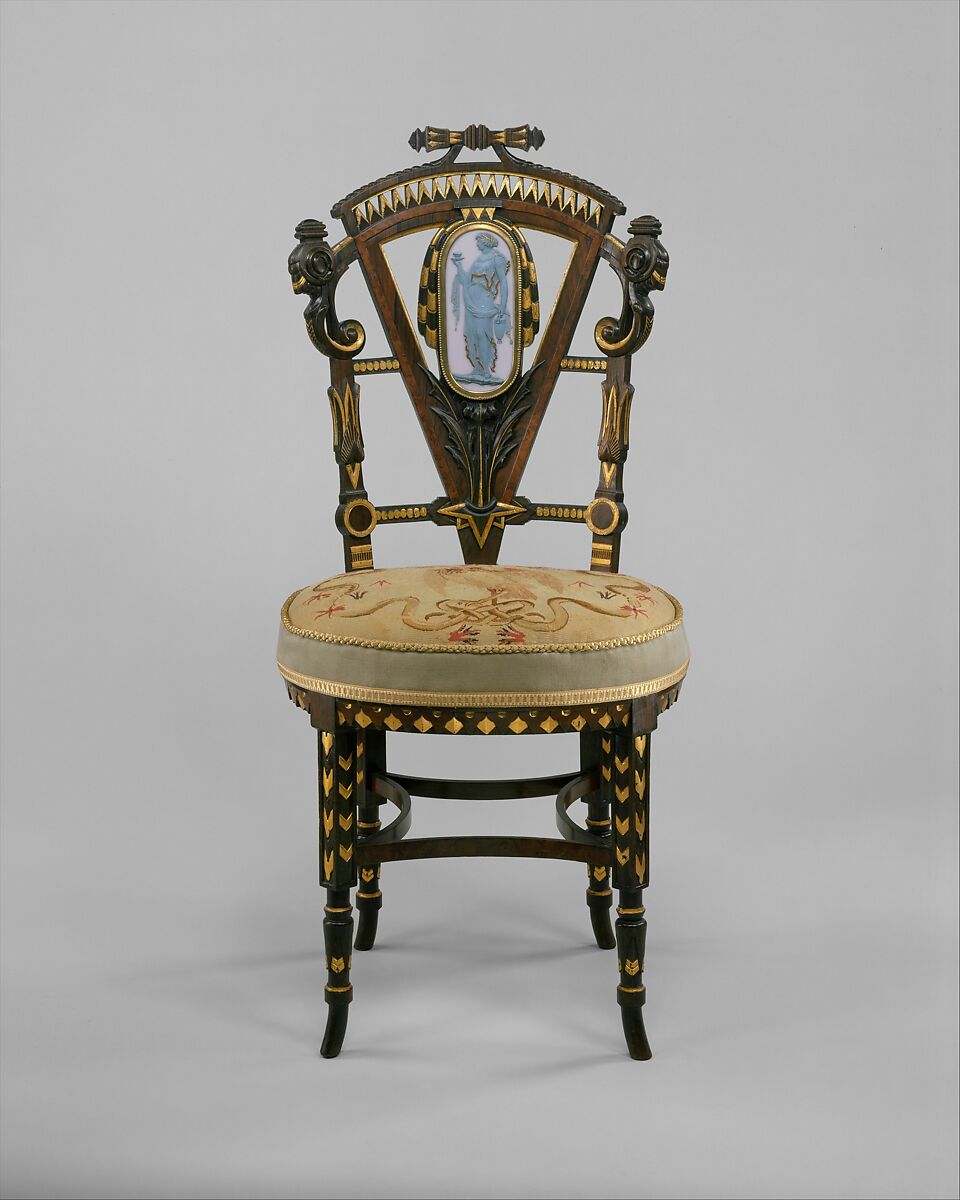
Image details
Source-supplied image. No retouching or generative changes by The Daybreak. Teasers may crop for layout.
Looking at the two forms together prevents a common mistake in design history: treating influence as exact copying. A structural idea can move into a different market and carry new visual signals. The Met chair is useful precisely because it does not look like a stripped-down industrial product. It shows how an influential form could be absorbed into a more elaborate object.
Fewer pieces do not settle the economics
A later chapter complicates the story further. Verner Panton’s 275 S chair, put into production by Gebrüder Thonet in 1966, used molded plywood to create a single cantilevered form. Cooper Hewitt describes fourteen laminated layers and a stackable shape. The chair demonstrated an ambitious manufacturing idea, but its high price kept sales limited. Technical economy in the number of components did not automatically produce an inexpensive object.[4]
This comparison separates three things that are often bundled together: a simple-looking design, a small number of parts and a low cost to make and distribute. They may reinforce each other, but one does not guarantee the others. A continuous surface can require demanding tooling and production control. A chair with several parts may ship efficiently and be assembled where it will be used.
For a maker, the useful exercise is to follow the object through its entire life before judging its elegance. How is the material formed? Where does labor occur? What occupies warehouse space? Which joint can be repaired? Which part is difficult to replace? Those questions reveal design decisions that a front-facing product photograph often conceals.
Thonet’s crate of disassembled chairs remains such a memorable detail because it makes an invisible constraint tangible. The object had to work in a room, but first it had to reach the room. A good chair could become a widely available chair only when the system around it made that journey practical.
Sources & further reading
Original reporting and research behind this article.
- Thonet: 214 chair, design and distribution historyUndated reference; consulted September 12, 2026
- Cooper Hewitt: Bent into ShapeApr 23, 2015
- The Metropolitan Museum of Art: Side Chair, about 1875Collection reference; consulted September 12, 2026
- Cooper Hewitt: A Sinuous SeatOct 22, 2019